Bulgaria and Heading Home

There are only a few pictures in this post. Go here if you just want to see all of the pictures for Bulgaria and heading home summer 2015.

Warning: there are a lot of churches in this batch of photos. But don’t miss the bears.

Our first night in Bulgaria

We crossed into Bulgaria on the morning of Tuesday 11 August, over mountain roads from Xanthi in Greece. The scenery stayed much the same in the mountains with twisty roads and a nice place for a lunch stop. Most of the road signs, when they existed, had the place names in Roman letters as well as Cyrillic.

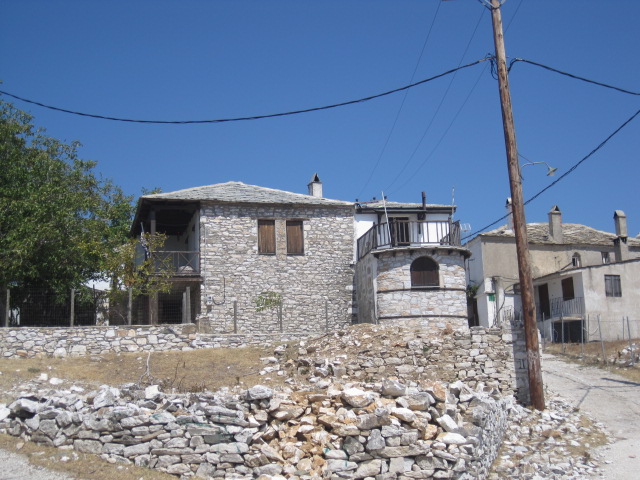
The first town in Bulgaria was Zlatograd, down from the mountains. We had no trouble in getting Bulgarian leva from an ATM and then had a brief walk round the area called the Ethnographic Area Complex where there are several interesting old houses. A lady was demonstrating weaving on a huge loom in one house, but there wasn’t a lot to see in the museum.
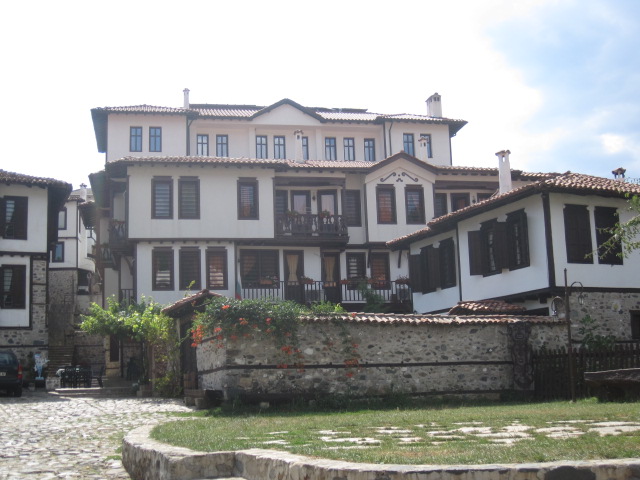
House in the "Ethnograp​hic Area Complex", Zlatograd,  Bulgaria

House in the “Ethnograp​hic Area Complex”, Zlatograd, Bulgaria

We had booked a small hotel called Friends Villa (in English) for the night in a village called Enquets not far outside the town of Kardzhali which was rather drab. Finding the road out of Kardzali was interesting as there weren’t any signs, but eventually we got on to the right road. The hotel was pleasantly new. The room very nice and the owner spoke good English. We seemed to be the only people staying there.

The dinner menu was sort of OK. When we sat down to eat we remembered the lovely salad we had when we went to Bulgaria before. It’s called shopska and consists of chopped cucumber, tomato and sometimes green peppers and onions, topped with grated cheese. The cheese is called sirene and is a rather like feta but not as sharp. We liked it so much that we bought some to bring home.

When we went down to breakfast the next morning, we discovered that the owner had gone out leaving a lady in charge who didn’t speak any English. We managed to get some food, but she did not know how to use the credit card machine which had run out of paper. However we were glad we had decided not to stay in any of the hotels in Kardzhali which would almost certainly have meant parking on the street.

Perperikon and westwards

Our reason for stopping in this area was to visit Perperikon, a spectacular archaeological site on the top of a hill. It was here that Alexander the Great received the prophecy that he would conquer the world.
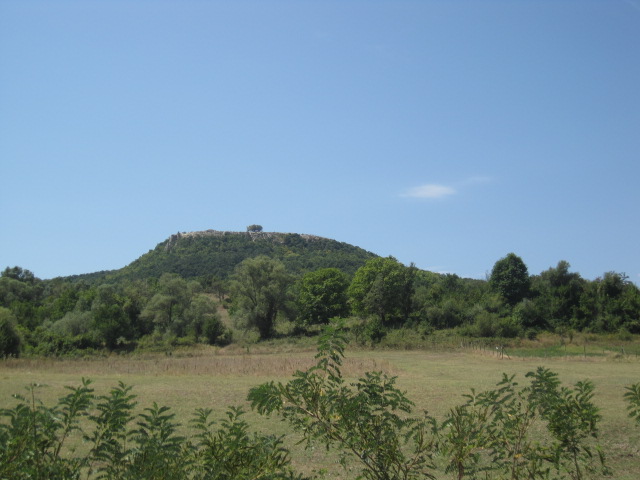
The site of Perperikon (

The site of Perperikon

We managed to find Perperikon without any problem only to discover that we had to park near the bottom of the hill and walk up in 35C with not much shade The path up was paved and not at all difficult. When we got near the top most people were turning off up a lot of steps, but we decided to carry on along the path which now became narrower and went through a nice forest.

We got to the top in about 40 minutes hearing more and more noise. We found a large number of people working on an archaeological dig and some of the site was roped off. The view was spectacular and we were able to see most of it. It was well worth the walk up in the heat. Martin walked down the steps but I preferred the forest trail. There were plenty of tourists at Perperikon but hardly any others from the west.

We drove back to Kardzhali and then headed west through more farmland, villages and lower mountains. All the houses had red roofs sloping at the same angle. Cows were wandering around on the main road. We had a lunch picnic at a table near some traditional haystacks.
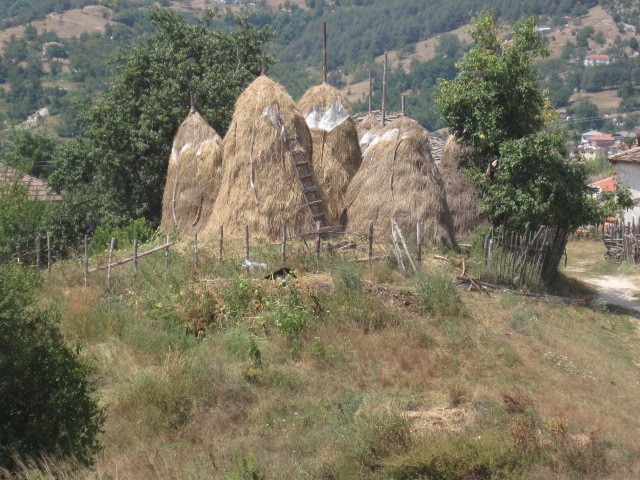
Haystacks in Bulgaria

Haystacks in Bulgaria

We had not made any arrangements for accommodation for our second night in Bulgaria, and decided to go to Pamporovo which is a ski resort. Ski resorts are usually very quiet out of season and you can get a good deal in the few hotels that are open.

The guidebook recommended one very tall hotel which had balconies overlooking a wooded ravine. It was open and we were first offered a room with no view. When we said we would look elsewhere the manager appeared and told the receptionist to take us to another room which turned out to be an apartment with a good view, for very little more money. There were several other people staying there and dinner and breakfast weren’t at all bad.

Trigrad Gorge and Devil’s Throat Cave

Next on our sightseeing agenda was the Trigrad Gorge, where the road was very narrow, but fortunately in the bottom of the gorge, not on a narrow ledge. We passed the first of several mosques we saw in Bulgaria on the way there.

The main sight in the gorge is a cave called, for a good reason, the Devil’s Throat. There is a deep waterfall inside the cave and nobody knows exactly where the water goes underground. People have put objects down it and they come out at the other end after about 4 hours. You have to take a tour and so we joined a large group. The guide spoke some English, but the most of what he said was in Bulgarian.

We soon discovered that the Bulgarians have rather different ideas about cave safety than the Italians. The steps were narrow and rather steep and the handrails rather thin. We had to walk some way down and did just see the waterfall. Coming back out was worse. It was a different route and at one stage there were over 100 steep steps going up. I found it better to wait a bit and then take a run at the steps, but we were behind an old lady who was very slow. If anyone had slipped, I think everyone could have fallen back like dominoes to the bottom.

Perhaps one cave was enough in Bulgaria.

Thank goodness I am out of the Devil's Throat

Thank goodness I am out of the Devil’s Throat

After recovering a bit, we drove through the gorge to the end and found ourselves in a nice valley with farmland and just a few houses. We had to come back the same way and then went some way into another gorge nearby with the the same kind of narrow roads and scenery.

We spent the night at Dospat, just turning up at a hotel recommended by the guide book. The restaurant was on a lovely terrace overlooking a reservoir. Plenty of locals were eating there and we could park just off the road.

Dancing Bears

After leaving Dospat we headed north on more twisty roads, dodging more cows and staying well behind a small truck which was very overloaded with hay bales. The scenery was still quite mountainous and it rained just a bit. We had to eat our lunch in the car and were passed by some Roma in a horse and cart.

Our destination was the Dancing Bear Rescue Park at Belitsa, but it’s not actually in Belitsa but almost 20km further up into the mountains. The guidebook said that the road to it was not good, but we thought we would try it and found it newly paved, although still narrow. The last 3-4km were gravel but not much different from some forest roads in the US.

Dancing bears were finally banned in Bulgaria when they joined the EU. The centre has over 20 bears, which are housed in huge enclosures and very well looked after. It is funded partly by the Brigitte Bardot Foundation. We were met by a very nice Bulgarian girl who spoke fluent American. She told us a lot about the centre. There was also good video showing how badly the bears were treated and what had been done to them to make them perform.
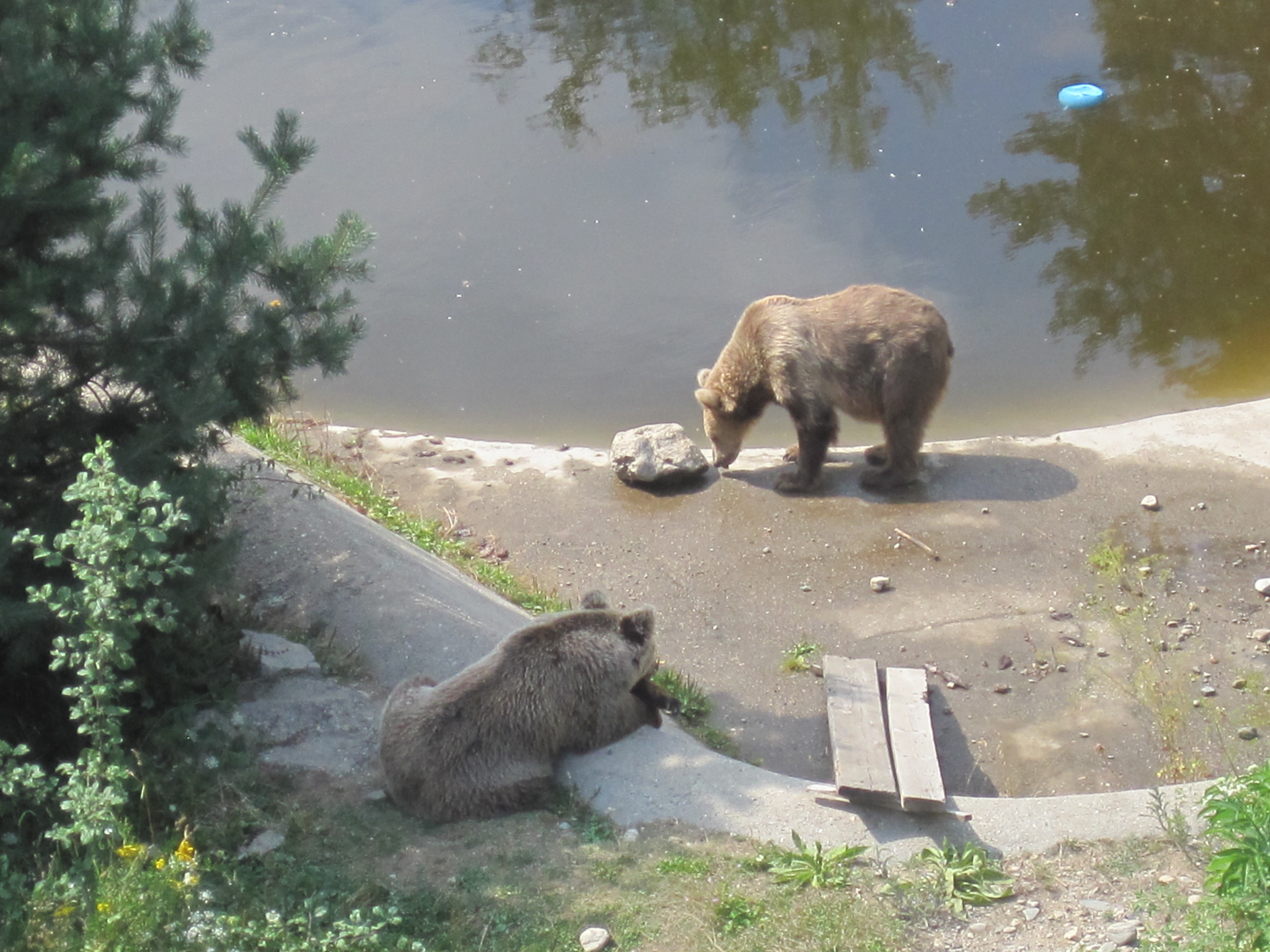
At the Dancing Bears Rescue Park, Belitsa

At the Dancing Bears Rescue Park, Belitsa

There’s a good path round the outside of some of the enclosures and we did the entire walk round. Some of the bears had bad or no teeth and one was very restless pacing up and down all the time. It was very sad to learn what had happened to the bears in the past but they are very well looked after now.

Rila Monastery

Our next night was spent at Hotel Park Bachinovo just outside Blagoevgrad which is one of the larger towns in Bulgaria. We didn’t want to stay in the town but had to find our way through it to go to the hotel which was on the edge of a national park. This was a nice modern hotel rather like an upmarket American motel room (but much cheaper). We had a lovely room with good wifi.

Dinner was not so good. The restaurant was outside and we were told that it was almost all booked – it was a Friday. We were taken to a table at one side. A very large number of Macedonians arrived for dinner and there was some music. We couldn’t see much of the entertainment from where we were. The service was really bad. It took a long time to get any food at all and then bits of our meal arrived in random order and not at the same time.

Breakfast was not wonderful either, but at least it was quiet as none of the Macedonians were staying there.

We went back to Blagoevgrad and then drove up the main road and turned off for the Rila Monastery which is probably the best known tourist attraction in Bulgaria. The drive to it is about 30 minutes along and slightly up a valley. When we got near we saw that there were a lot of people there. The monastery has only a very small car park and most people were parked along the side of the road. We carried on past the monastery and parked about 1km from it and so had to walk back. It was very crowded indeed and we finally found out that it was a public holiday in Bulgaria (Saturday 15 August). It also began to drizzle with rain a bit.

However it was well worth going as the whole monastery complex is quite spectacular. The paintings on the wall and ceiling outside the church were amazing. It would have taken hours to study them all in detail.
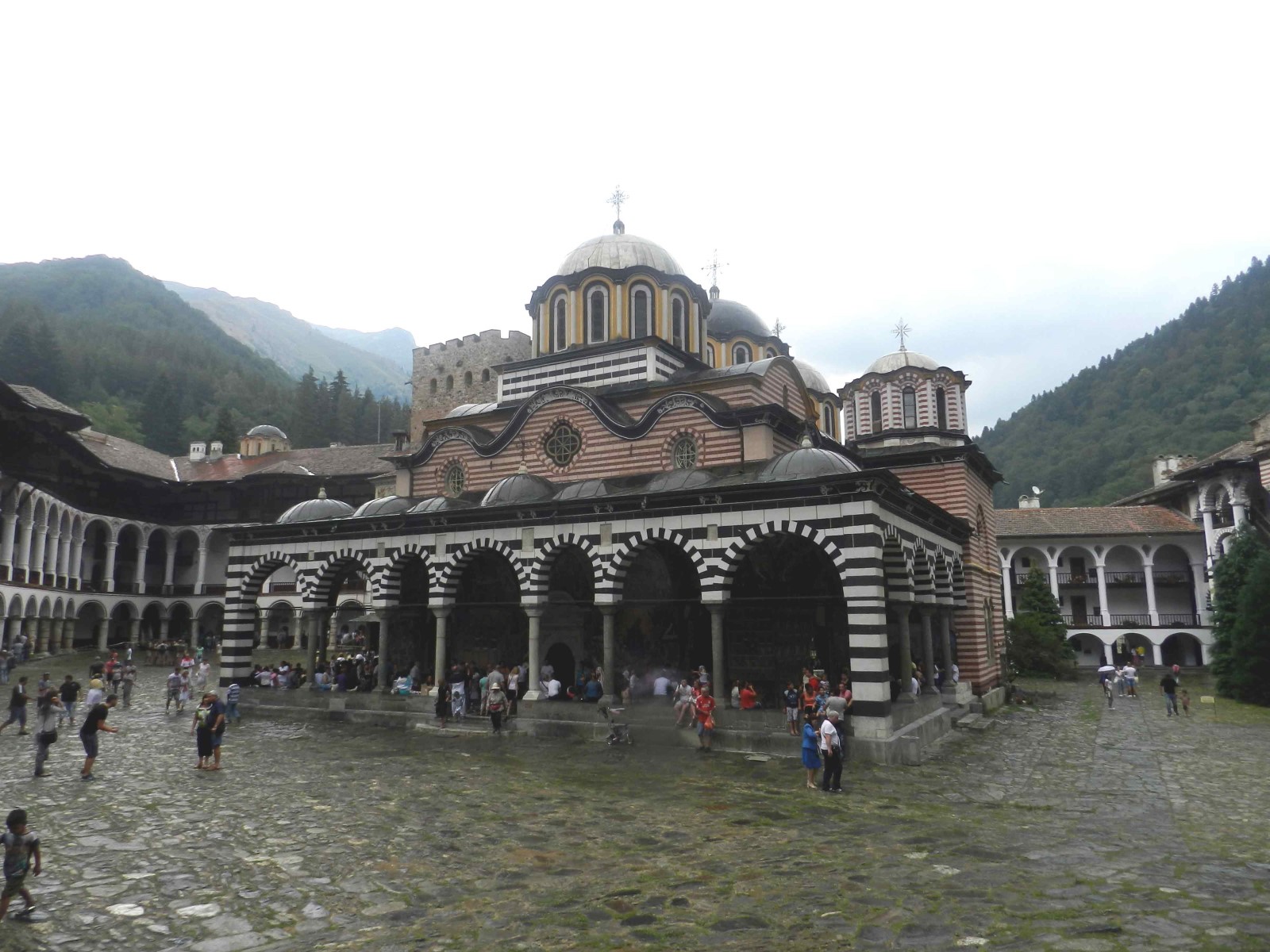
Church at the Rila Monastery

Church at the Rila Monastery

Most of the people there seemed to be eating doughnuts with chocolate for lunch, or chips with some gloop on top, and the restaurants were busy. We finally found a space in one for lunch which was sort of OK. The weather brightened up and we had a pleasant drive back to the main road, stopping to buy a large painted dish on the way.

Chiprovtsi

We were then on the main road going north towards Sofia. When we got there we found that the ring road was mostly under construction with a dearth of road signs. We were heading for the village of Chiprovtsi where we had booked a small hotel. It was by a stream in the centre of the village. The owner spoke very good English and we had a huge room, more like an apartment. I think we were the only people staying there. Dinner was good.

In the morning the owner asked if we would like to try what the Bulgarians usually have for breakfast. It was pieces of a kind of fried dough, a cross between a doughnut and a chapati, and quite light. We ate them with some cheese and home made jam and rather liked them. It certainly made a change from the usual buffet of cold meat, cheese, bread and jam, and cereal if we were lucky.

There is a small monastery just outside the village of Chiprovtsi which we liked a lot. It was very peaceful and they had a nice garden including some interesting cacti.
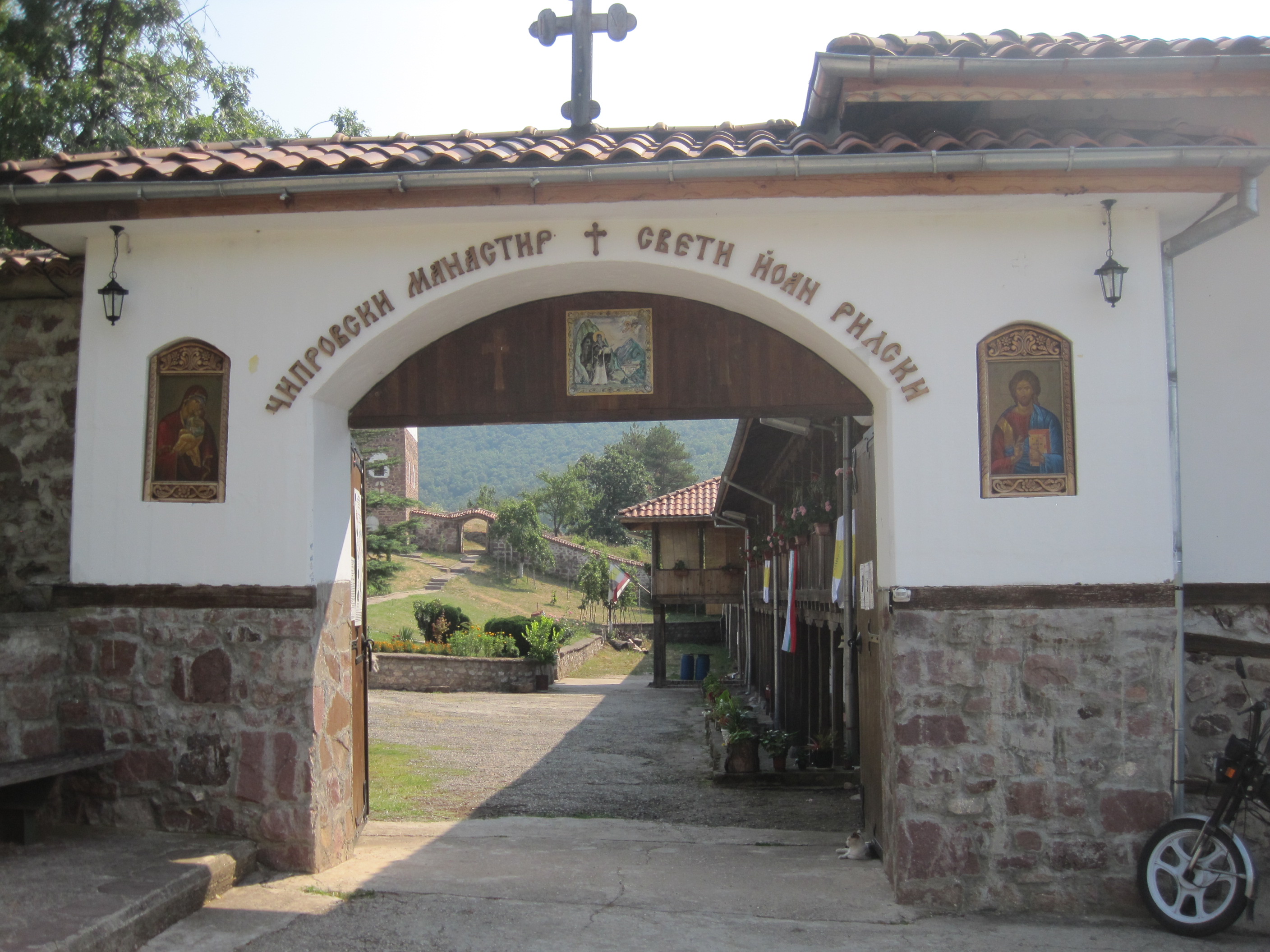
Entrance to Chiprovtsi Monastery

Entrance to Chiprovtsi Monastery

Magura Cave

It was a lovely day the next day when we drove northwards. We stopped to take a picture of a field of sunflowers, but it was late in the season and they weren’t as good as the spectacular ones we saw when we went to Bulgaria before.

We also stopped to take some pictures of the hill-top fortress at Belogradchik, but didn’t go in as we had been there before.

Our main objective on that day was to visit the Magura Cave. Did I say cave again? Perhaps we should have learnt something from the Devil’s Throat Cave.

There is a short walk from the car park up to the entrance and we arrived just before a tour was starting. Nobody spoke English at the ticket office but Martin managed to get two tickets. The guide didn’t speak English either and so we had little idea what to expect. The guidebook said that the cave contained some prehistoric paintings which was what we wanted to see.

We had to walk down quite a long way inside and it was very slippery indeed, with a rather feeble handrail. There was a level area at the bottom of a lot of steps and we found out that the tour went very much further down. I really decided that I had had enough by then as it was so slippery but Martin had gone on with the flow of people down further.

A few people were left on the level area with another guide who spoke English. He told me that only this small group were going to see the paintings which were through a little tunnel from there. There was an extra fee for seeing the paintings. I didn’t have any Bulgarian money with me but he let me go along with them anyway.

The paintings were excellent, but I also remembered that the ones in Lascaux in France were closed to the public to protect them. We were allowed to take as many photos as we liked and could walk right up to them. The guide explained quite a lot in English for my benefit.
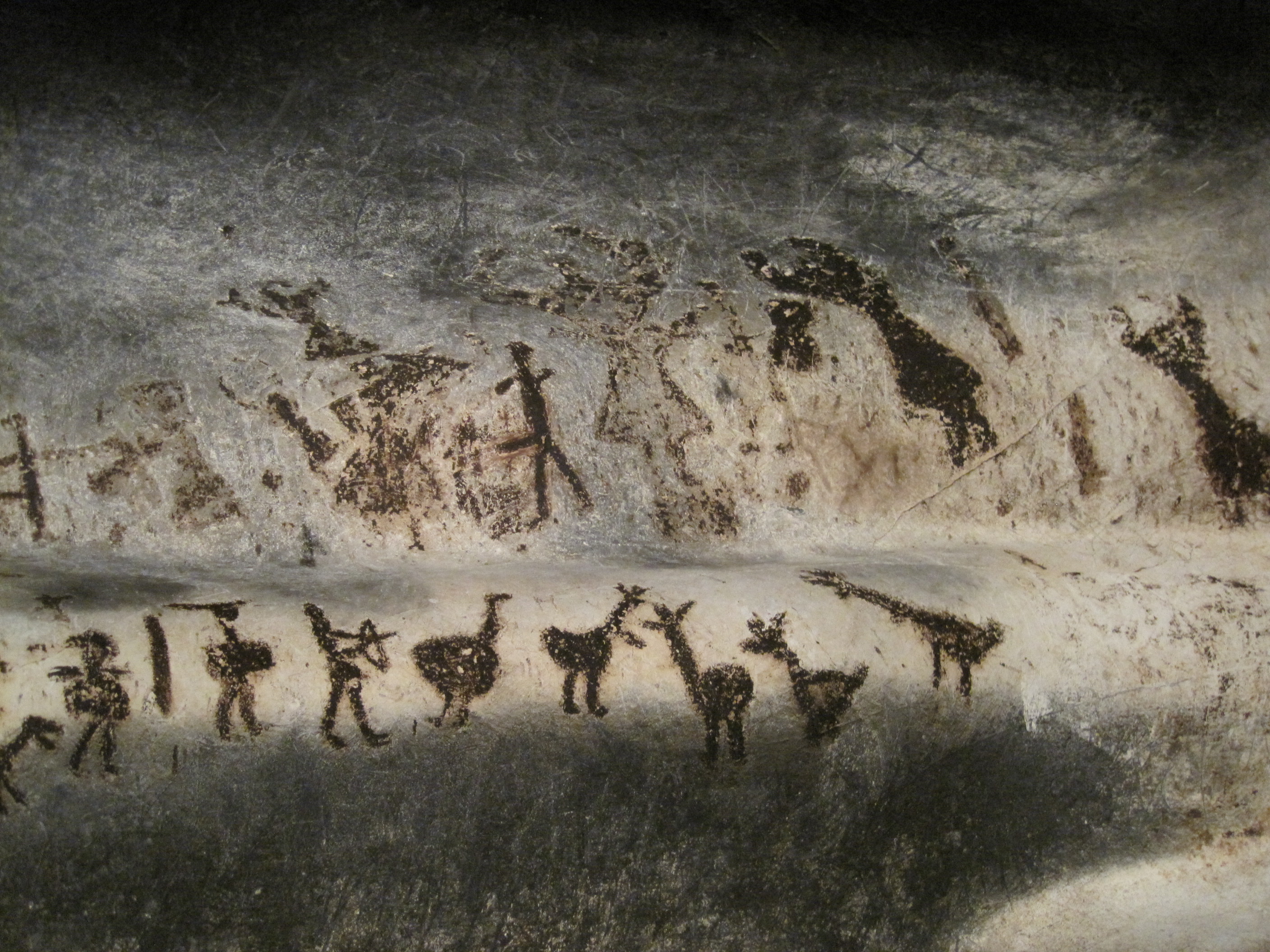
Prehistoric cave paintings in Magura Cave, Bulgaria

Prehistoric cave paintings in Magura Cave, Bulgaria

When we left the paintings it turned out that this small group was then going down to do the rest of the cave and that it would take about an hour. I asked the guide why they didn’t have more handrails and he said that they had no money. I decided not to go on and so climbed back up the slippery steps on my own, clutching on to the wall.

I had been sitting outside the ticket office at the top for about 15 minutes when Martin appeared. The walk inside the cave was so far that visitors were brought back to the car park in an ancient trolley.

Impressions of Bulgaria

What were our impressions of Bulgaria? There is some lovely mountain scenery. The roads are OK if you don’t mind a few potholes and can cope with the roadworks around Sofia. The food was OK – we really liked the shopska salad. A guidebook is a necessity if you want to get round on your own. It’s also very helpful to be able to read the Cyrillic alphabet for road signs etc.

We saw a few British cars and came to the conclusion that they were either Brits living there or Bulgarians who had been working in England and had bought the cars and driven them home.

The people are more reserved that the Greeks, but they were helpful. Most of the young people speak very good English. The Internet was very good everywhere we stayed.

But don’t visit any caves!

Romania

After the Magura Cave, we ended up having a very late lunch of shopska and bread rolls, and a conversation with a Greek truck driver who was waiting for a part for his broken down truck, in a small town on the way to the border with Romania.

There is new bridge across the Danube near the border town of Vidin. When we got near it, there was a very long queue of trucks, but we followed some cars past the trucks and drove over the bridge and were soon in Romania. We quickly turned north off the main road into Romania. The scenery was much flatter and there was a lot of farmland. Occasionally we could see the Danube in the distance on our left.

When we went to Romania in 2009 we stayed in a lot of small modern B&Bs and hotels and were expecting to find somewhere like this for the one night we planned to stay there. There was nothing until we came to the first big town Dobreta-Turnu Severin which is a rather drab industrial town on the Danube. We didn’t find anywhere we wanted to stay in there and so drove on along the side of the Danube. The guidebook mentioned several hotels in Baile Herculane which is just off the road northwards towards Timişoara.

Time was getting on and it was starting to rain again. We turned off and drove some way on a twisty road through a valley where there did appear to be a lot of hotels – too many to choose from. There were also a lot of people about, presumably there to take the spa waters.

The guidebook mentioned the Hotel Roman which turned out to be a 10-storey concrete building by the side of the river built on the site of the Roman baths. This was definitely a relic of the communist era with a dingy interior (lots of dark red carpet) and very boring or non-existent decor. The three ladies on the reception desk did not speak any English but pointed to a board with room prices. It was getting dark and drizzling with light rain and so we took a room on the 10th floor which was fairly small and could definitely do with a new bathroom.

Not all the lifts were working either. The dining room was one huge space. There was a waiter who spoke English and we got a reasonable meal. We had planned to charge it to the room, but were told we couldn’t do that. We didn’t have any Romanian money on us and ended up paying 9 euros in cash for dinner for two.

The room price included breakfast for which we were given a voucher of 30 lei (about 7 euros). Every item on the breakfast menu was priced individually including each bread roll, egg, pat of butter and small dish of jam. This was one of the very few places where breakfast was not a buffet. We had to pay for the entire stay in cash in euros, but it didn’t exactly break the bank.

We found a better road back down the valley to the main road. We did not do any sighteeing in Romania but drove northwards to Timişoara where we filled up with diesel, and then turned westwards to Hungary.

Hungary

We crossed into Hungary near the town of Makό and went into the town to get some forints. Everywhere seemed cleaner and tidier than in Romania and Bulgaria. It looked more like Western Europe. We drove through Szeged and on to our first night’s stay in Hungary at a very nice hotel which was out in the country near the town of Lajosmizse. It was easy driving on the motorway (no potholes).

The hotel had been a country house and extended to include some motel-like rooms which were very well furnished. Dinner was good and there was some entertainment, presumably because a big group was staying there. Four musicians played a variety of music, not just Hungarian. One of them was playing a string instrument, a bit like a zylophone with many strings. I found out later that it was a cimbalon. He even played it blindfolded at one stage. There were four dancers including two females who danced balancing a bottle-like object on their heads. It was good to see that the dancers were young and carrying on Hungarian traditions.
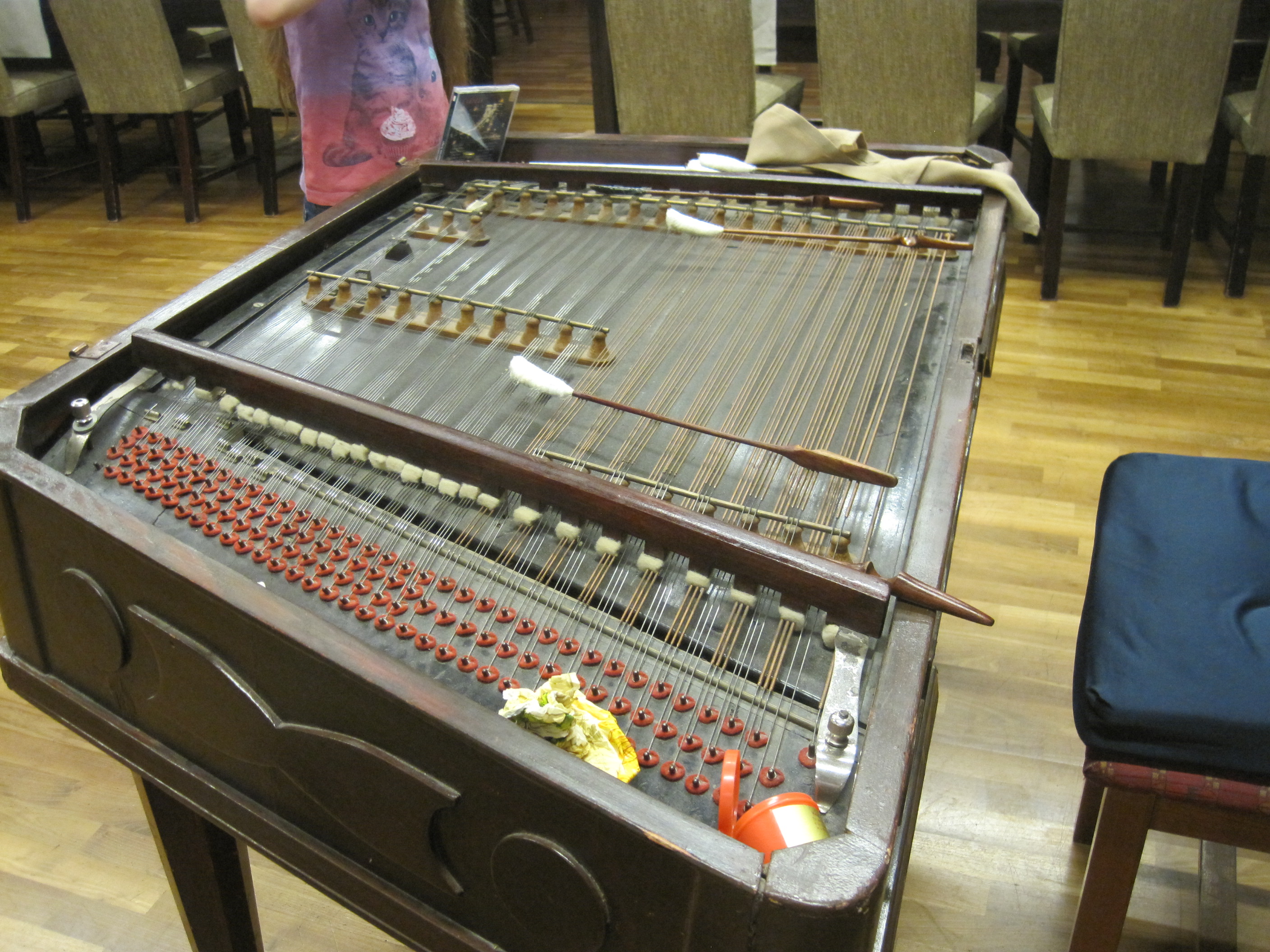
A cimbalon, part of the entertainment at the Geréby Kúria Hotel

A cimbalon, part of the entertainment at the Geréby Kúria Hotel

The next day we drove the fairly short distance to Budapest on the motorway. We easily found a parking space at the bottom of the castle hill in Buda and walked up a lot of steps to the main tourist area. It was drizzling a bit as well, but not enough to stop us walking round. I saw that the area had been renovated since my last visit in 1998 and everything was clean, neat and tidy. We had to queue for some time to buy a ticket to go into St Matthias Church and the ticket selling could have been better organized. The interior of the church was quite different from those we had seen earlier and very ornate in a different way.

We ate lunch in a restaurant on the Castle Hill and then it began to rain more heavily and so we headed back to the car and drove out northwards for our next night at Visegrád on the Danube where we had a room overlooking the river. There is a big fortress on a hill overlooking Visegrád. We drove up there the next morning in mist and rain and decided that it was not worth going in when we would not see anything of the view.

We did stop at Ezstergom on the Danube to see the Basilica which is the largest church in Hungary. It was enormous, too much to see in a lot of detail, but I really liked the metal friezes, especially the donkey. I took another photo of the Danube in misty rain.

Ezstergom Basilica, the largest church in Hungary

Ezstergom Basilica, the largest church in Hungary

Vienna, Krems and Melk

Then it was up the motorway to Vienna. The road east of Vienna was pretty bad with potholes etc and then we had to navigate through the evening rush hour to the parking garage we had identified as being the nearest to the old city for some quick sightseeing. It finally stopped raining not long before we arrived.

First stop of course was a konditorei for a cake and coffee then we spent a couple of hours in the old town, visiting the cathedral where there are some amazing carvings of toads on the wooden handrail to the pulpit, and also just wandering round. It was very busy, but the traffic had eased off when we drove out about 7.30 pm to a small hotel in Gablitz, a short distance away in the Vienna Woods.

We did a bit more sightseeing in Austria, first to Krems which is a very old town on the Danube which was almost as large as Vienna in the Middle Ages. The old town was on a hill. It was a steep climb up to the old church, through a covered tunnel of steps but well worth it to see some paintings on the outside. The main street was pedestrianised with nice shops and cafes. There was more interesting architecture in the old town and not many tourists.

Then it was on to Melk to the huge abbey. I ducked out at that point for a rest but Martin went round most of it. There were plenty of visitors there as well.

Czech Republic

We had one night in the Czech Republic where we stayed in a B&B in Rožmberk on the banks of the Vltava. Dinner in a nearby hotel wasn’t wonderful but it was interesting to see yet another country and a different part from where we went in 2009.

The town of Český Krumlov, about 30 minutes from Rožmberk, is one of the main tourist attractions in the Czech Republic and we ended up spending several hours there. There is a huge castle complex on a rocky hill overlooking the Vltava. We did not go inside but walked round all the courtyards. There was a lot of exterior decoration and some of the walls were painted to look like they were made of large bricks.
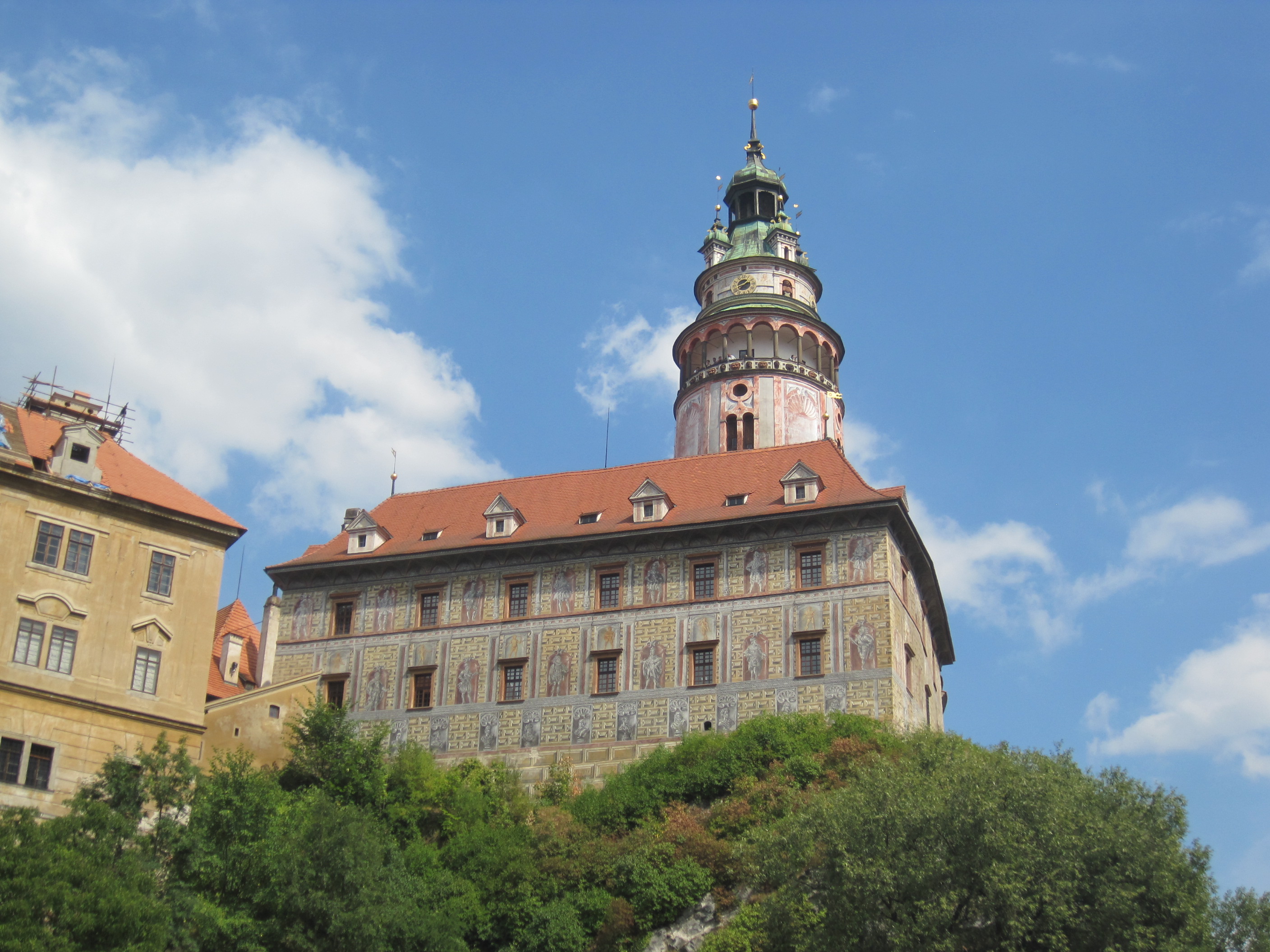
Part of the castle at Český Krumlov, from the other side of the Vltava

Part of the castle at Český Krumlov, from the other side of the Vltava

The castle actually straddles two hills or rocks and there is a high bridge between them which goes down several levels to the ground in between.

There is a moat (now dry) which was occupied by a rather miserable looking bear who was eating some fruit. I thought he would be better off at the Dancing Bear Park.

Český Krumlov was very busy with tourists and there are plenty of restaurants. We had lunch outside in one overlooking the Vltava.

We needed to do some shopping there and went to the German chain Kaufland. We did see a sign to Tesco which was further out but didn’t go to see what it was like.

Austria again

Then it was back to Austria on some small roads past a lake and through some lovely scenery, part of which is a national park in the Czech Republic. There were a lot of cyclists here.

We had decided to spend two nights in the same place before setting off on the 1000 or so miles back home. We had settled on Gasthof Greiner near the village of Julbach and right on the border with Germany which was only about 5 metres away. This turned out to be an excellent choice. The food was very good indeed and we had a lovely and very typical Austrian view over a large green field.

Our main activity on our full day there was a walk of almost 3 hours. It was lovely scenery. We ended up going further than we intended by missing a turning in the middle of a wood, but all turned out fine in the end. Martin did another walk later on this time in Germany.

After all the recent goings on with migrants, I wonder what has happened to that border point now. The owner of the hotel told us that before the Schengen agreement, it used to be open for 4 hours a day.
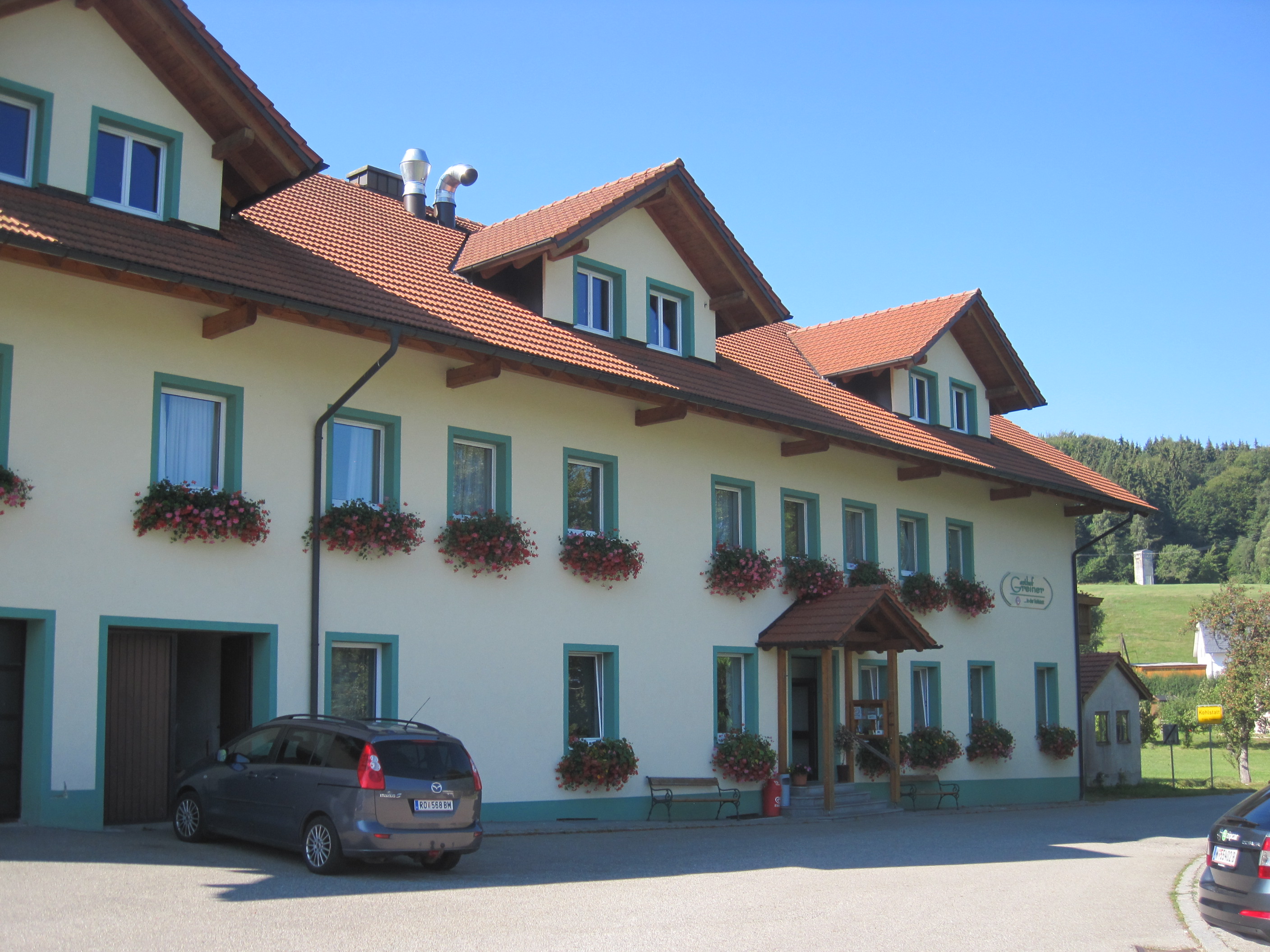
Gasthof Greiner, near Julbach, Austria. The yellow sign on the right is in Germany.

Gasthof Greiner, near Julbach, Austria. The yellow sign on the right is in Germany.

Germany and home

Driving back through Germany was not without interest. We left on a Sunday and encountered the worst traffic jam we had found on our trip, where several motorways join around Nuremberg. I was driving and we managed only 27 miles in 1.5 hours and began to wonder what it would be like around Frankfurt, but there was hardly traffic at all when we got there in the late afternoon.

It was fortunate that we hadn’t booked the hotel we had identified for that night as we would not have got there before dark. Instead we stopped at Limburg in a hotel just outside the old town. Dinner was a nice Turkish meal in a square in the old town. The next morning we spent an hour or so looking round there and found some curious metal sculptures attached to the outside of one house. The cathedral was huge. We didn’t stop long there but did find a stone tomb which was raised up and resting on some sculptures, two of which were of monkeys.

After we left Limburg we just kept driving with little traffic even around the Brussels Ring until we reached Dunkirk where we went to the hypermarket to get cheese, pate and other goodies to take home, as well as filling up with diesel. We spent the last night at a logis de France in Bollezeele about 15 minutes from Dunkirk. The hotel was very elegant as was the food which was perhaps a bit too rich for us after almost 7 weeks of travelling.

We came back on DFDS to Dover and drove straight back home with only 2-3 very brief stops.

It was a great trip. We didn’t see a single migrant/refugee. And we did 6068 miles in 48 days. Phew!

That’s a big thank you to Martin who drove almost all of the time.

You can see all of the pictures for this part of our trip here.
Posted in Uncategorized | 1 Comment

Greece

There are only a few pictures in this post. Go here if you want to see all of the pictures for Greece summer 2015.

At last we were in Greece. The hotel in Igoumenitsa (one of only a very few) turned out to be much better than the booking.com reviewers described. We had a good breakfast and there was even a lift.

Crossing northern Greece to Kalambaka

Then we set off across northern Greece. They have finally finished the Egnatia Odos, a new road through the mountains which was under construction for years. Driving on a dual carriageway was very fast compared with struggling up a twisty mountain road behind trucks and other slow moving vehicles. And it wasn’t raining either, unlike our previous times on this road.

We soon got to the turnoff for Metsovo a town of Vlachs (originally nomadic shepherds who have their own language) high up in the mountains and took advantage of the sunshine to walk round, for once not getting wet in rain there.

We then decided to carry on using the old road which was fine in spite of guidebook warnings about it not being maintained any more. It was lunch time and the map showed a lake a few kms just off to the left. It turned out to be a lovely area. We drove along by the side of the lake passing a few remote farms, then found a picnic place on a spur by the lake.

First lunch spot in Greece

First lunch spot in Greece

This was the first of several picnic stops we found in Greece where there was a hexagonal wooden structure with benches around the inside and, more importantly, a roof for sunshade. It was very peaceful and we stayed there for a while. We were amused at the pile of logs nearby where somebody had painted faces on the ends.

The it was down and down to the plain in northern Greece and on to Kalambaka where the room in the B&B we had booked turned out to be large with a sitting area and a small kitchen. It was up a steep hill from the main road and the view, once we had found it, was excellent.

We drove down into Kalambaka and had our first Greek dinner in a small plateia. The Greeks love to eat outside and I we hardly had a single meal indoors all the time we were there.

Meteora

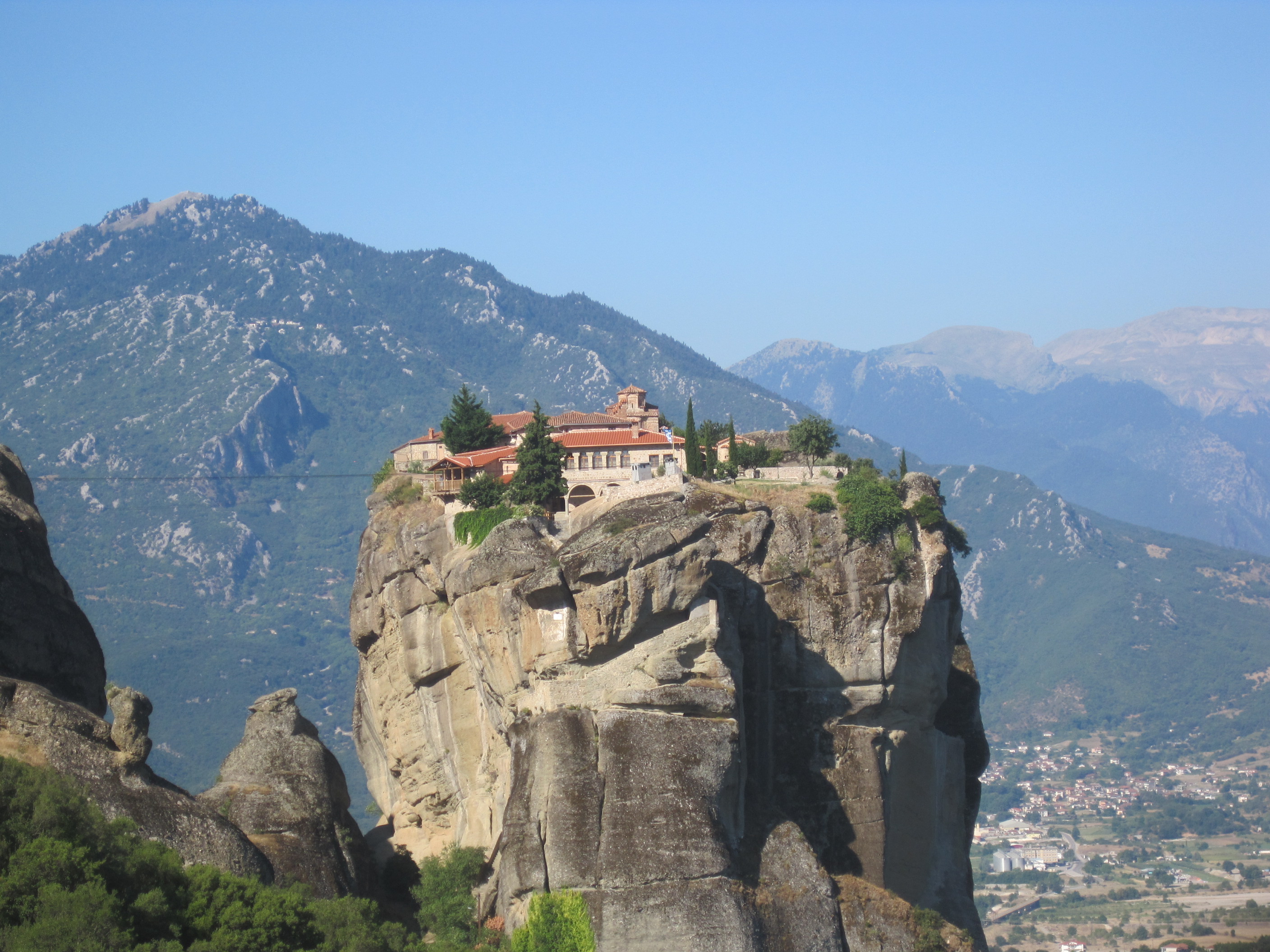
Our real reason for staying in Kalambaka was to see the monasteries at Meteora. We were last there in 1973, but not too much has changed except the number of visitors. They are all built on top of tall rocks and the monks used to be hauled up there in baskets. Now there’s a road and you can climb up steps to them.

We went first to Agios Stephanos where you can even park outside on the road. This one is now a convent with nuns. The church was very ornate and covered with paintings and gold decor. Like the other monasteries there was a small museum and a shop. I think it was here where I bought a hand-painted fridge magnet which the nun personalized with my name on the back.

Monastery at Meteora (which one???)

Grand Meteora Monastery

We decided not to go to the two big monasteries, Grand Meteora and Varlaam which we had seen before and so went next to the Holy Trinity Monastery. To get to it you have to walk down a long way then up steps and through a tunnel. I just waited in the car while Martin visited it.

I did do the walk up to Roussanou where you go up a lot of wide steps, then across a little bridge and up a some more steps. Roussanou is on a rock which is very small in area and is very compact on three floors.

Pelion

Pelion is another of our favourite areas in Greece. It’s a peninsular about halfway down the east coast of the mainland. Mount Pelion in the northern part is a high wooded area with plenty of walking trails. We drove down the Athens – Thessaloniki “motorway” which thankfully now has been converted into a dual carriageway, then through Volos (interesting navigation) and up a twisty road on to the mountain to the village of Kissos which has a lot of traditional houses and a typical plateia with a plane tree. The village car park was about 100 yards away. We found a place to stay in one of the old houses and had dinner nearby where I ate a tasty goat stew.

The following day (Wednesday 29 July) we did a circular tour round the northern part of Pelion on twisty roads all day. We went first down to the coast at Agios Ioannis which was quite crowded, but with a long beach. We picked up a tiripites for lunch and ate it on the tiny beach at Damachouri which was a lovely spot, but without much parking space. We stopped at one or two other villages, but it wasn’t a long day and we stayed another night in Kissos.

Pelion is great for walking, mostly on the old paths called kalderimi which tend to go straight up and down. We got up at 6.30 the next morning and had just a small bite to eat before setting off on foot at 7.15 down to the village of Mouresi, mostly on kalderimi. We got there about 10.15 and had a coffee in a cafe where the owner called a taxi to take us back to Kissos in time for breakfast in the B&B – it finished at 11. The owner clearly thought we had been mad to walk, but we were mostly in forest and it wasn’t too hot.

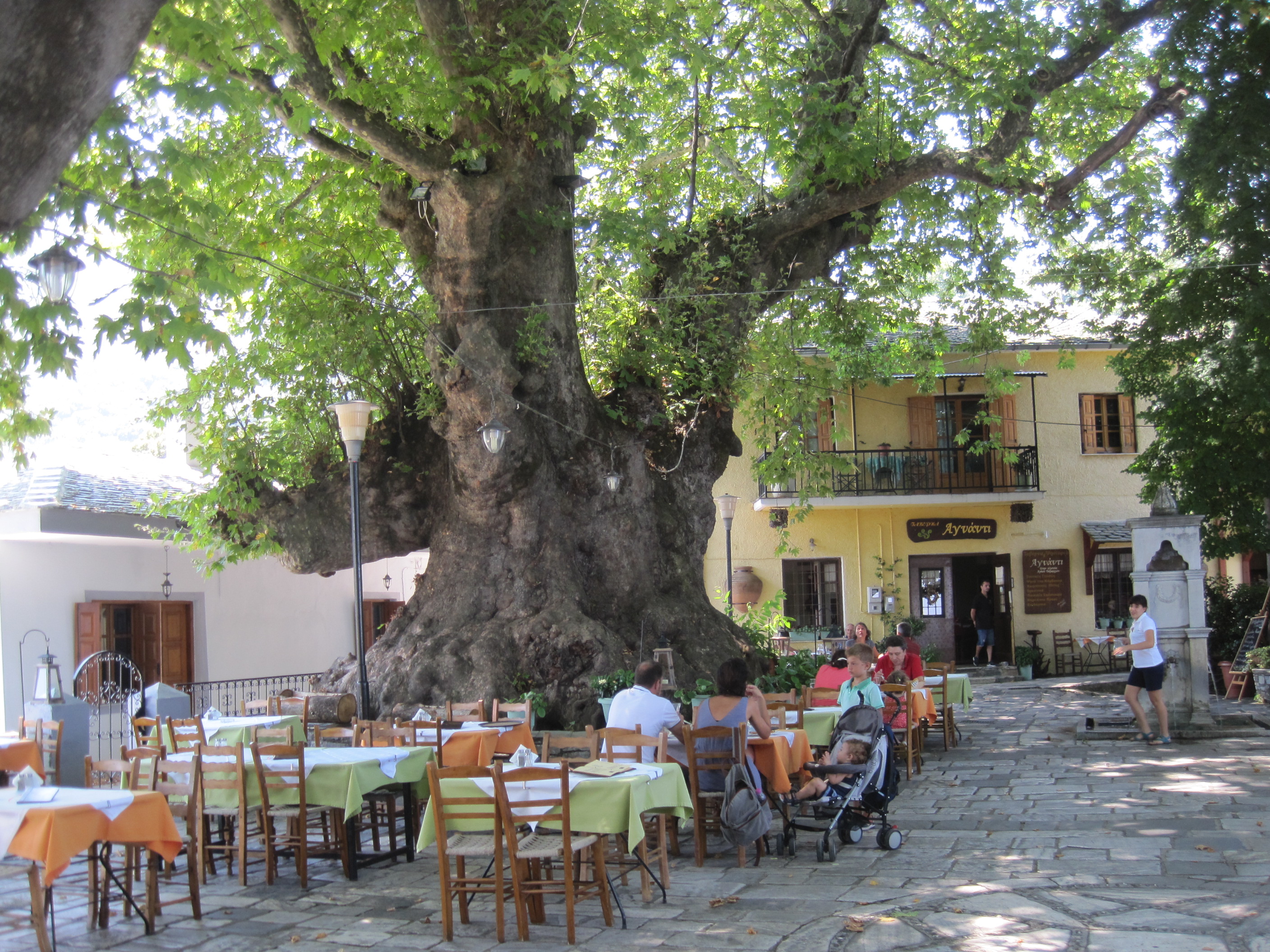
We then set off southwards on Pelion. We stopped again at Tsangaradha, which is a very straggly village, and finally found the huge plane tree which the guide book had mentioned.

Giant plane tree and plateia inTsangaradha, Pelion

Giant plane tree and plateia in Tsangaradha, Pelion

Further south in Pelion the scenery began to look more like typical Greece with fewer trees and stony hillsides. We found a half-board room in a hotel at Horta. This hotel was the only one we stayed in in Greece which was really intended for package tours. It was very good value, but the food was fairly mediocre.

Trikeri is the largest place in the very south of Pelion. It’s on the top of a hill. We went past some nice (and nearly empty!) beaches and drove up OK. We then tried to drive through the town, but got stuck with some narrow streets and bends. We had to turn the car round in a small space with a 3ft drop (no fence) at one side. Some of the villagers came out to look (and give directions). It seemed that we were not the first people to be stuck here. We did finally find the proper village car park and a lovely Greek church with whitewashed walls and blue painted doors.

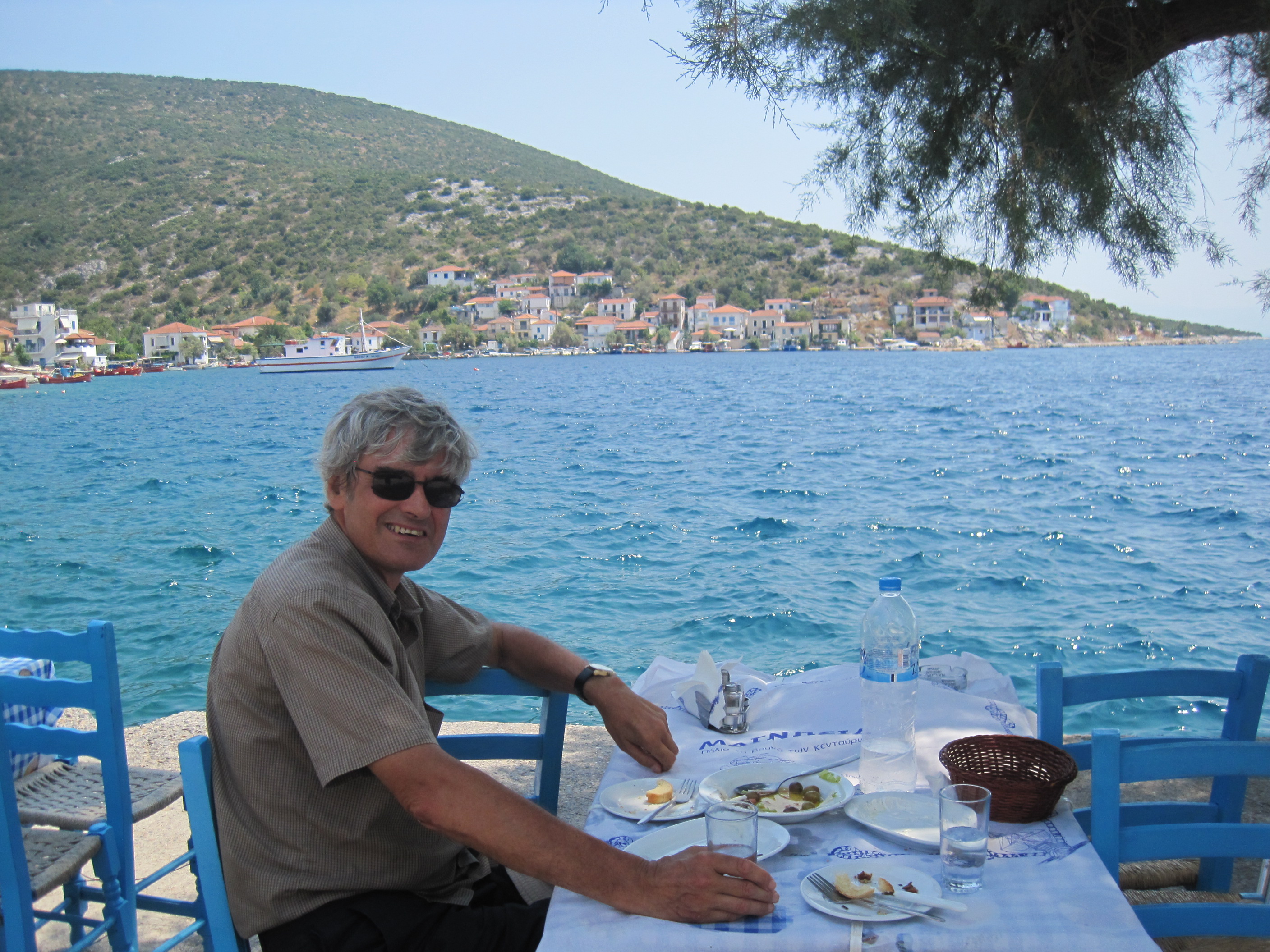
Agia Kyriaki was the southernmost point of our trip. It’s a fishing village and we ate our very favourite meal, a fish in a taverna by the sea.

Eating a fish by the sea at a taverna in Ayia Kyriaki: my idea of Greek heaven

Eating a fish by the sea at a taverna in Ayia Kyriaki: my idea of Greek heaven

We had more problems driving through this village as there was a very tight right hand turn then more narrow streets, but we did finally make it.

We had booked a room in another traditional Greek house (Katerina) in Vyzitsa back in the north of Pelion. This was beautifully and tastefully furnished and the owners were very kind. Vyzitsa is all on a steep hillside. There was a track to drive up to the house, but we could walk down some steps and to the village to eat. It was very quiet (hardly anybody eating there) in spite of it being one of the main tourist sightseeing villages in Pelion. Business seemed very slack.

We decided to stay another night and to do a walk down to Kala Nera on the sea. The owners seemed to think we were slightly mad and kept saying that it was 10km. We set off later this time, but it wasn’t too hot in the forest. It was almost all downhill. The kalderimi were a bit overgrown and we did the last bit on a rough road which was further but easier to walk.

Kala Nera was as crowded as all the other beach places we saw. We had some lunch in a taverna on the beach then walked back to the main road to find that the little office by the bus stop was closed (for a long lunch). No buses came, but there was a taxi number on the window. We phoned it and soon got back to Vyzitsa.

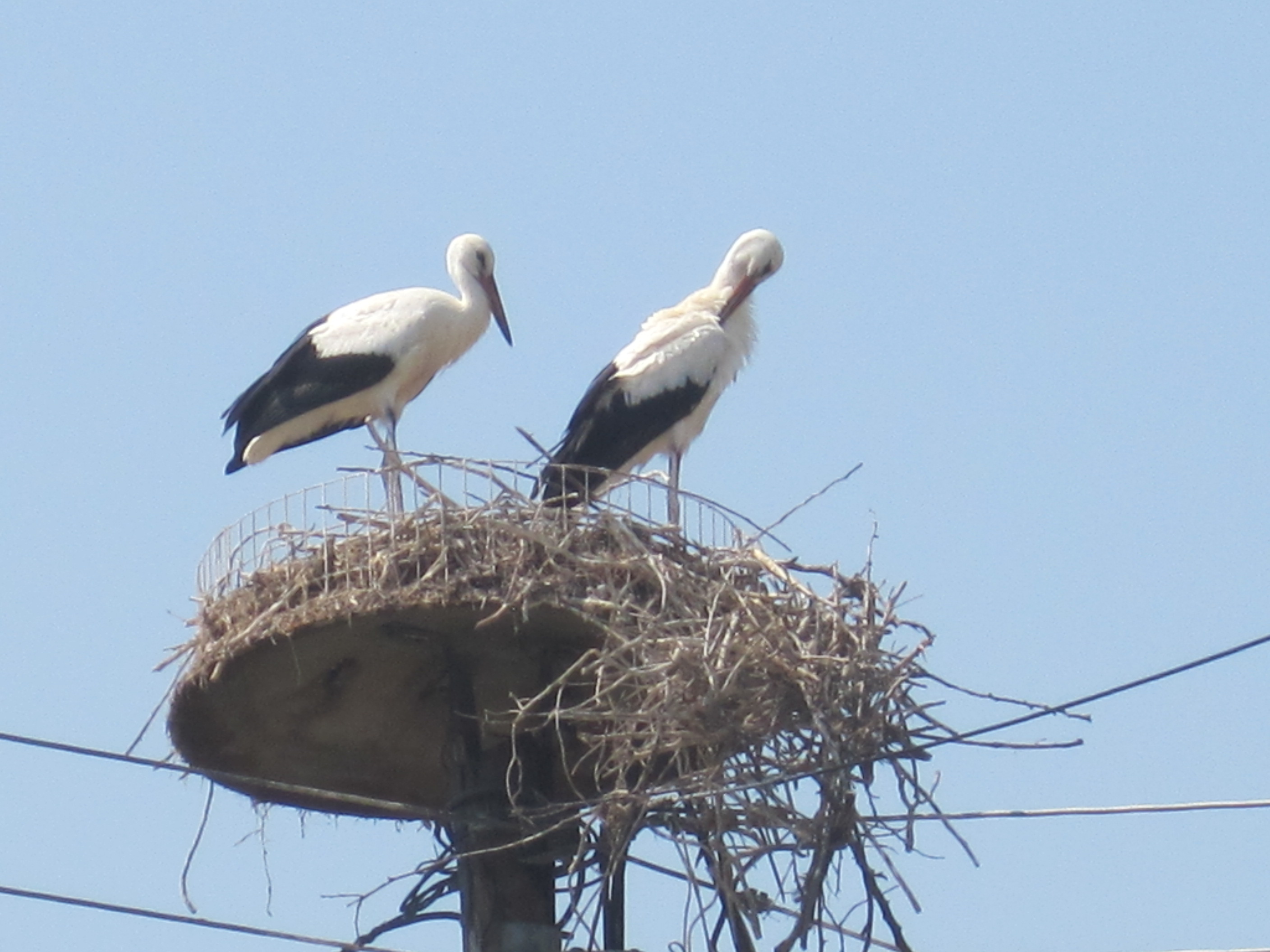
We finally left Pelion on Sunday 2 August and stopped first in the big town Volos to get some more money and food. Sunday was a good time to park in a big town. We had coffee in a cafe by the water then set off northeast over more small roads towards the coast. To begin with it was fairly flat. We drove past a lake and then a village where there were storks in a nest on a lamp post. We expected to see more storks but these were the only ones we saw on the whole trip.

Storks somewhere north of Volos - the only ones we saw.

Storks somewhere north of Volos – the only ones we saw.

The east coast north of Pelion

We then went over the mountains and down to the coast, meeting a large herd of goats in one place, then finding another picnic shelter with a spectacular view. The coast north of Pelion is not well known in Greece, but we found a huge sandy beach which was almost empty. However the town of Ayiokampos was not empty – there were plenty of day trippers from Thessaloniki as it was a Sunday.

We didn’t fancy staying in any of the many beach room places there and drove back a bit to a place called Pension Paradies which was run by a German. It was very Greek and we had another nice meal.

Ancient Macedonia and Aristotle

The beaches were emptier the next day, but we carried on north by the coast and then inland to the village of Vergina where there are a number of Macedonian tombs including that of Philip, the father of Alexander the Great. The tombs had all been turned into a museum with a dome-like grass-covered building over them and it took a while to work out exactly what this building was. There were replicas of the tombs but you couldn’t go into the actual tombs, only as far as the entrance doors. The museum had a good display of artefacts found in the tombs, a lot of which were gold.

We stayed in a B&B next to the ancient theatre where Philip was murdered. We were the only people there again.

There was more sightseeing the next day when it was again very hot. We could see why they built the old towns on the tops of the few hills. We looked round the old town of Vergina and saw the shrine at a place where St Paul is supposed to have preached, also plenty of old houses and some churches.

Then we went to the remains of Aristotle’s school where he tutored Alexander the Great. This was a lovely place by a river and I could just imagine them walking up and down philosophising. There was a new visitor centre where one of the researchers insisted on giving us a lecture about the site.

Site of Aristotle's School

Site of Aristotle’s School

Our last site that day was Pella, the capital of Ancient Macedonia. This is a huge area (with a modern town in the middle). We saw some of it, including three 4thC BC mosaics which are still in situ and protected by shelters, but I found it too hot (37C+) for the rest of it. The museum in the north of the town, however, was excellent. It contained more mosaics which had been removed from the site, and plenty of other artefacts. The building itself was huge. There were a few other tourists in the museum, but none at all at the site.

We didn’t make a good choice of place to stay that night. The guidebook and booking.com showed plenty of places at Stavros on the east coast of the northern part of Halkidiki. We had booked what appeared to be, and probably was, the nicest hotel, but the whole town was rather grotty and very busy. We walked about 1km to get some dinner and ate a rather poor meal by the beach.

Stagira, the birthplace of Aristotle is a bit further down the coast. It was a pleasant but fairly small site. There’s a longer walk round. Martin did a bit of the walk but it was again very hot.

We went on the motorway to Kavala where we finally found a Greek cake shop. Somehow they didn’t seem to exist at the right time of day anywhere else where we had been. Then it was a short drive to the village of Toxetes where we had booked a B&B which turned out to be almost a whole house. The owner Eleni (and her 4 dogs) lived next door. There were 4 bedrooms and a large sitting area upstairs and a kitchen, dining and sitting area downstairs. We hardly saw the other people staying there, a family in another room downstairs.

Toxetes is a small village but we had a wonderful meal in a restaurant in the centre. There was also a mosque, the first of several we were to see in this part of Greece.

Thassos

We had been thinking about going to the island of Thassos, but were a bit worried about long waits for the ferry etc. Eleni told us that there would not be a problem and so we booked a room on the northwest of the island and took the ferry from Keramoti the next day.

It’s a flat bottomed boat and you just turn up. A ferry was loading when we got there and so I rushed to the ticket office where the Subaru was deemed to be a large car. As we were driving on we were told “lady out, driver only” and so Martin drove the car down another ramp to the lower deck, forwards this time.

Driving on to the Thassos ferry

Driving on to the Thassos ferry

The trip took only about 45 minutes and we drove off in Thassos town. It was still only late morning and so we looked round there for a bit. It’s a pleasant place with plenty of tourist shops selling the usual things of honey, oil and herbs as well as ornaments and bags and plenty of restaurants across from the water. We saw a good few Brits wandering round.

Our first two nights in Thassos were at a small hotel called Louloudis Fresh. It was modern and we had a nice room facing the sea. We needed to drive to the nearest restaurants, two together on the beach. We ate in each of them. The food was fine, but the tables were very close together.

Thassos is almost circular and we spent our first full day driving round the island. It’s only about 60 miles round, but we took two detours up into the mountains to the villages of Megalo and Mikro Prino which had a lot of traditional houses, then also to Theologos, another mountain village quite high up.

We had trouble in another narrow street in Skala Marion in the south west, but finally extricated the car and ate our lunch on yet another crowded beach. We stopped at the Archangelou Monastery which is in a spectacular position by the sea. Photos aren’t allowed inside, and we had to use a big zoom from some way off to get a good view from the outside.

One of our aims in going round the entire island was to find somewhere to stay for another two nights. We had read that Aliki in the southeast was the nicest place. None of the places there had online booking, but we stopped at the Hotel Archontissa perched on a hill overlooking the promontory at Aliki. This was a traditional Greek hotel and we decided to stay for the following two nights.

View from our hotel, Aliki, Thassos

View from our hotel, Aliki, Thassos

We got to the Archontissa quite early the next day and walked down to the tiny beach below it, then back up to the road and to Aliki village where we had lunch, avoiding the octopus hanging up, in a restaurant overlooking a beach that was so crowded that you couldn’t walk on it. There’s a nice one hour walk round the promontory where there are some ancient marble quarries. We completed the walk but it was very hot again and we had walked a long way by the time we got back to the hotel and were dehydrated.

A large party (20+ people) from Istanbul arrived for dinner just as we were eating. They all spoke excellent English and one of them told us that they were going to make some noise and hoped we wouldn’t mind. It turned out that he was a musician and his repertoire was quite varied. For the benefit of everyone else eating there, he introduced every song in near perfect English. The dancing started later on and some of the Greeks at the restaurant joined in.

Some of the younger people in the group started talking to us in excellent English – they had heard Martin say to me that they were speaking Turkish. They told us that their parents had met at a business school in Istanbul and remained friends ever since. The party was winding down a bit when we went to bed at 1am.

The next day (Sunday 9 August) was very quiet. We stayed in the hotel where there was a lovely view from the balcony and read up about Bulgaria. We also e-mailed Eleni for another night in Toxotes.

We aimed to take the ferry back to the mainland in the late afternoon of 10 August. In the morning we drove up a gravel road (with a steep unfenced drop on one side) to Kastro which was once an important town in Thassos. It’s about 450m up on the top of the hill. Now almost all the village is deserted. We found just one building occupied which was a cafe where we had lovely yoghurt, honey and nuts. The owner took us into the small church next door. There were several other tourists there and we chatted to them a bit. Most had come in hired jeeps although it was just possible to get there in an ordinary car.

Deserted houses, Kastro, Thassos

Deserted houses, Kastro, Thassos

Our last meal in Thassos was lunch at Skala Sotiras on a beach which wasn’t quite as crowded. The late afternoon ferry was a smaller boat and much less busy. We were soon back at Toxetes and ate in the same restaurant there, this time in the plateia.

We have been to a lot of Greek islands and Thassos ranks quite high up. The scenery was very nice, quite varied and there’s plenty to see, and plenty of sandy beaches and good food as well.

However I would not go there again in the height of summer as anywhere near or on a beach was very crowded indeed. Most beach restaurants were jam packed (with a lot of heavy smokers). Most of the people had driven there from Bulgaria and Romania just for the beach. After all it’s only a day’s drive from Sofia or Bucharest. We saw quite a few cars from Istanbul as well.

I would definitely go again in May or September. We found some lovely walks but it was too hot to walk in the full sun.

We visited one more place in Greece, the town of Xanthi where there is some interesting architecture in the old town on a hillside. We saw Turkish people who live in Xanthi and we found a mosque with a burial ground outside it.

When we left Toxetes for the second time on 11 August, we had done 3578 miles from leaving home.

Greece in summer 2015

All in all it was great to go to Greece again. Outside the beach areas it was very quiet. It seemed that tourism was down a lot – presumably because of the news about their economic situation. We had no problems at all getting cash or in using credit cards where they were accepted. Everywhere looked just as normal, although we heard from Eleni, who was a civil engineer, and others that business was very slack. However, the Greeks are optimists and very outgoing and we enjoyed meeting a lot of them.

We didn’t see a single migrant or refugee.

You find all the pictures for Greece here.

Posted in Uncategorized | Leave a comment

Austria and Italy

There are only a few pictures in this post. Go here if you just want to see all of the pictures for Austria and Italy.

Why this trip?

On a cold Saturday evening in early May, we started to think about what to do in the summer. Martin said he would like to do another road trip in Europe. Then we thought we might have a rest in the middle of it and looked to see what HPB had available. One of their trulli in Coreggia in Southern Italy came up for the third week in July and so we grabbed it online.

And if we were going to the heel of Italy, Greece wasn’t much further.

We didn’t do much more about the trip for ages – there was gloom in the news about migrants in Calais and no money in Greece. The only thing we did do was to book the opera in Verona.

Setting out

Finally we booked DFDS from Calais to Dunkirk for the morning of 10 July 2015 and left the day before to stay the night in a B&B pub in Kent. We had a good conversation with two Aussies in the vehicle in front of us in the ferry queue. They were going to do a charity drive from Brussels to Ulaan Bator. I saw on their blog that they made it – the day before we got home.

The ferry was busy but fine. DFDS seem to assume you are going to eat all the way, as all the seating room was by the restaurants. Martin did his usual tour of inspection of the ship and found there wasn’t much room to sit down outside either. We wanted to avoid Calais, but I think the P&O ships from Dover to Calais are better.

At Dunkirk we filled up with diesel and stocked up with cheese etc at the Auchan hypermarket, then drove to our first night’s stay, a very typical logis de France near Metz which served a very typical (and good) logis meal.

The next day was quite a long drive to western Austria. We took a detour via Baden Baden to drive the Schwarzwaldhochstrasse from where there are great views down to Strasbourg and eastern France. It reminded me of the Blue Ridge Parkway in Virginia. A fine Saturday in summer was not the best day for this as we had trouble finding a parking space at the Mummelsee, the beauty spot lake on the highway. We didn’t stay long either as it was so crowded.

Austria – hiking in the Bregenzerwald

Then we braved the speedmerchants on the German autobahn, and drove along the north of Lake Constance to our next night at the village of Alberschwende in the Bregenzerwald in Voralberg. This area has typical Austrian scenery with open fields and forest. The hotel was typically Austrian. We were amused at the egg-boiling machine at breakfast. You put your egg into a little holder and drop it into a special container of boiling water, hooking the holder on the side. You can then cook your egg for as long as you want.

It was lovely weather and the next morning did a short hike at the top of the pass in the Bregenzerwald to the Korbersee, a great picnic spot and a lovely lake with cows nearby and little ducklings following their mother.

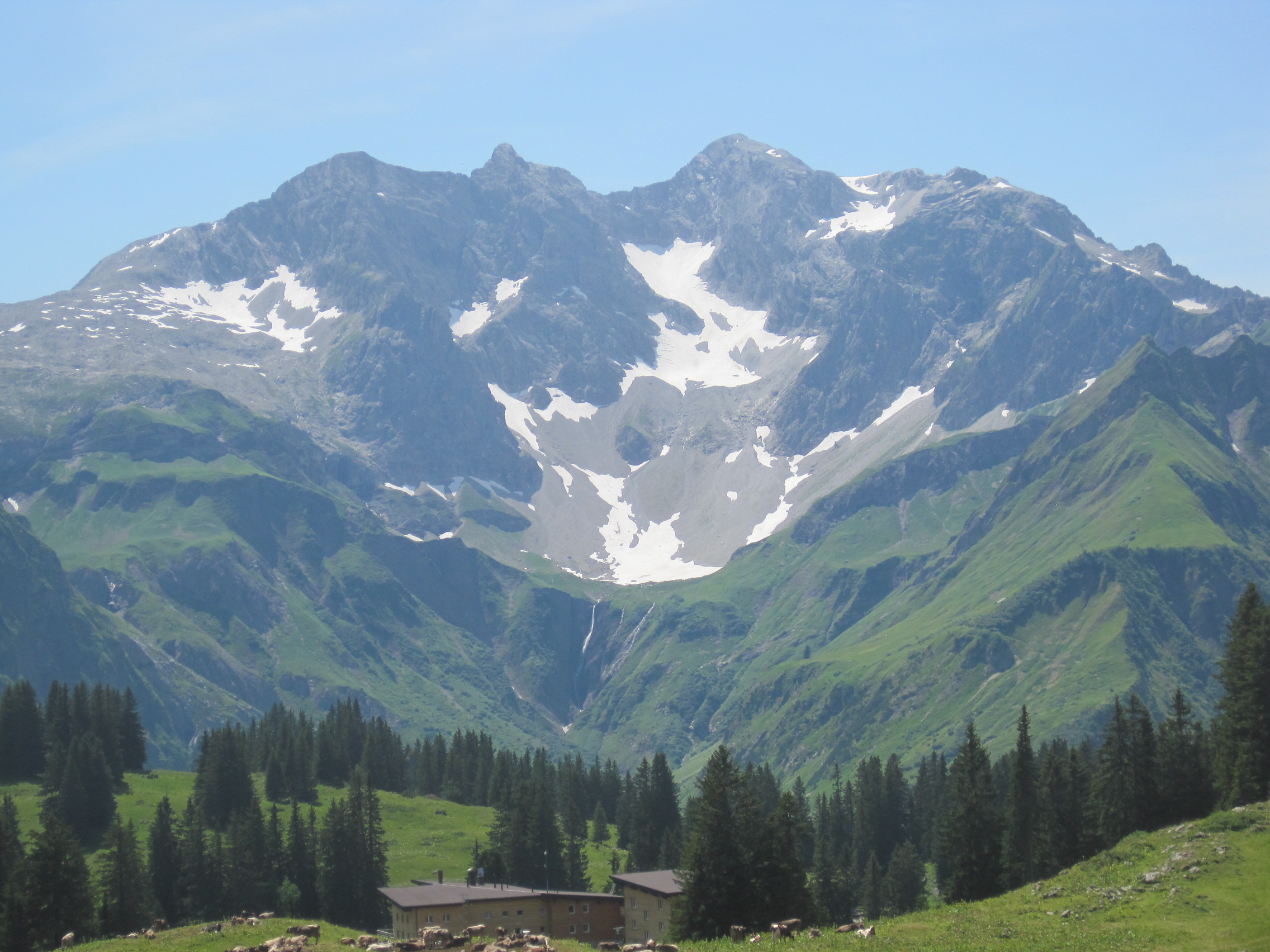
Hiking in the Bregenzerwald

Hiking in the Bregenzerwald

Our second night in Austria was at Nauders. We had a lot of trouble finding the B&B we had booked online (there was no name outside) and I missed the Wimbledon men’s final which was just finishing when I turned on my computer. To compensate we went to a rather posh hotel for dinner.

Over the Stelvio and into Italy

The next day (Monday 13 July) of course we had to take a detour on one of Martin’s favourite roads, the Stelvio Pass which is almost the highest pass over the alps. Getting to the top was fine as there are two different routes which converge near the top. We had last been there in the 1980s when it was very quiet. Now it has been taken over by bikers, hundreds of them, even a few on pedal bikes as well. There are souvenir shops and restaurants in the tiny flat area at the top. We eschewed the biker’s meal of hot dogs and chips and just had a very nice cappuccino instead.

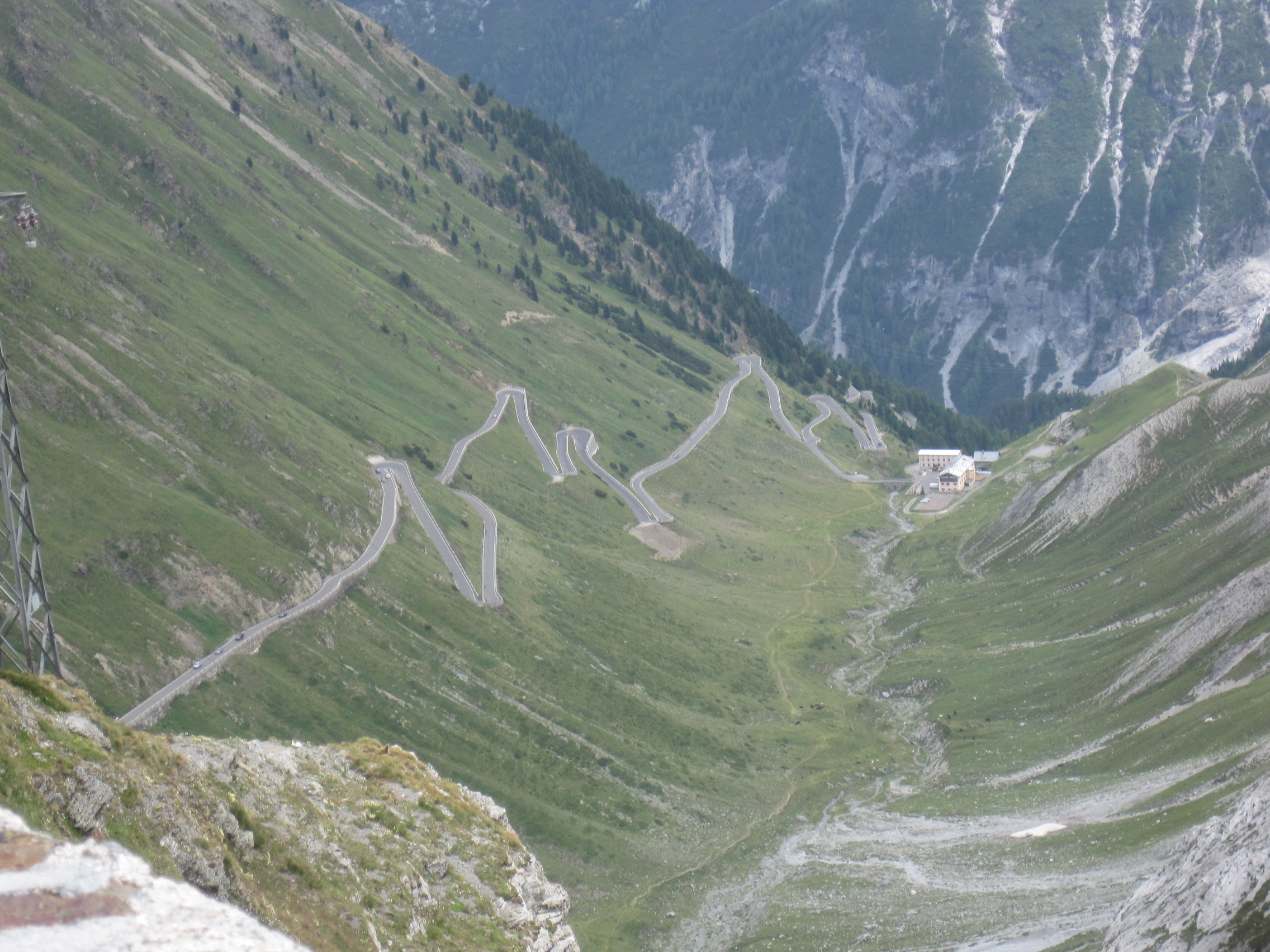
There are 48 hairpin bends on the road going down, all numbered, but we were soon down safely and drove on southwards.

The Stelvio Pass going down

The Stelvio Pass going down

Northern Italy

Lunch beckoned. We always look for a nice quiet place to have a picnic. We turned off the main road and went up the Senales Valley which was very narrow to begin with but then opened out into a lovely scenic area going to a ski place. We drove right up to the ski place and ate our lunch rather late on a grassy verge. The area looked so nice that we decided to stay the night in the valley. The tourist office found us a room in a farm B&B overlooking a lake at the village of Vernagt where there are German speaking Italians. There was no Internet but it was worth it for the location. We had dinner in a posh hotel nearby again.

The next day we drove down to the plain in the north of Italy where it began to be very hot. The first stop was Bolzano where we went to the archaeological museum to see the frozen mummified body of the Iceman Ötzi which dates to about 3300BC. There was an excellent life-size replica.

Then on to Verona where we managed to navigate our way to the hotel we had booked. This hotel had some spaces in a garage nearby so we had to park on the Italian equivalent of a double yellow line to dump our stuff at the hotel first. Fortunately it was still lunch time in Italy (about 4pm).

Verona and Assisi

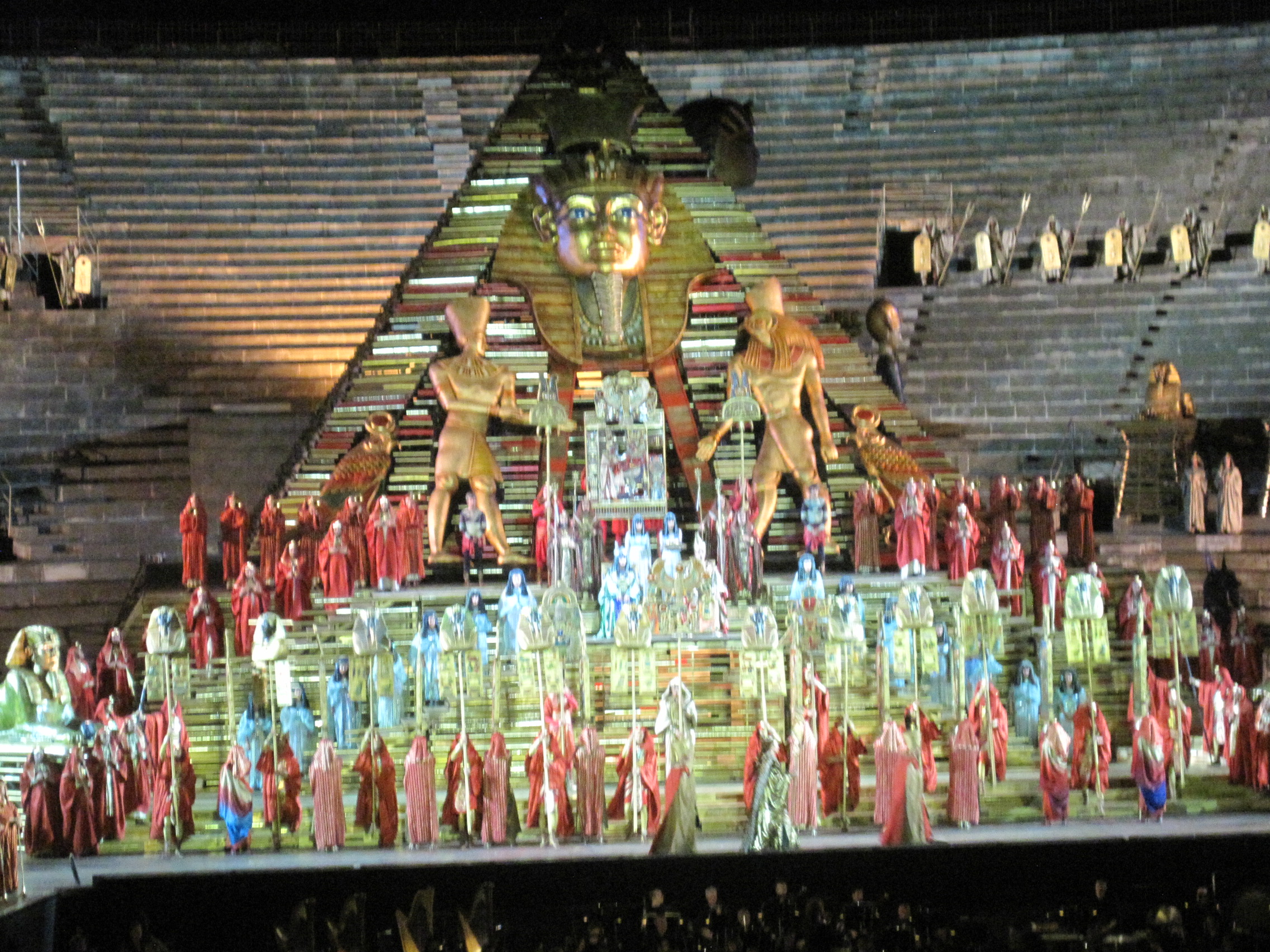
Then it was time for a rest before our night at the opera. For a long time I had wanted to go to the Verona opera festival and we were lucky that the performance was Aida at the time we planned to be there. It’s in a Roman amphitheatre in the middle of the town. After reading various blogs, we decided to go for more comfortable seats rather than sit on stone slabs for 3 hours. The performance was spectacular, with a cast of hundreds but no animals. It started at 9 and finished about midnight, in time for a gelato in the piazza outside the arena.

Aida at the Verona arena

Aida at the Verona arena

The next day we looked round Verona, along with very many other tourists. It was 35C. Even the hotel receptionist was remarking on the heat and the sights were about 20 minutes walk from the hotel. We saw Juliet’s balcony, the cathedral and plenty of typical Italian architecture. It was nice to duck into a few air-conditioned shops.

The it was on to Assisi, on some twisty roads and the Italian motorway through the mountains. When we were about an hour from Assisi, a warning light came on in the car, saying that there was a problem with the diesel particulate filter. We stopped at the next service place, a tiny one in the mountains while Martin delved in to the Subaru handbook which recommended getting it fixed asap. However we didn’t have much choice except to drive on. It seems that the problem had been caused by too many twisty roads and so not keeping the revs high enough.

We didn’t have any problem reaching the B&B we had chosen just outside Assisi. It was an olive farm and the owner spoke very good English. There was no dinner there but a nice restaurant 10 minutes walk away where we had a typical Italian meal, not one for tourists as nobody spoke English there.

The next morning Martin phoned our Subaru dealer in Otley who were reassuring, but we took the car to a very modern Subaru garage in the next town Foligno where there was one person who spoke very good English. They ran the engine for a long time to burn the gunge off the filter, and it was fine.

We decided to stay another night at the olive farm and so spent the rest of the day looking round Assisi which stands out on a hill. By now it was about 37C and there’s a steep walk up from the car park. We were fine but a party of American tourists of the usual American size appeared to be suffering.

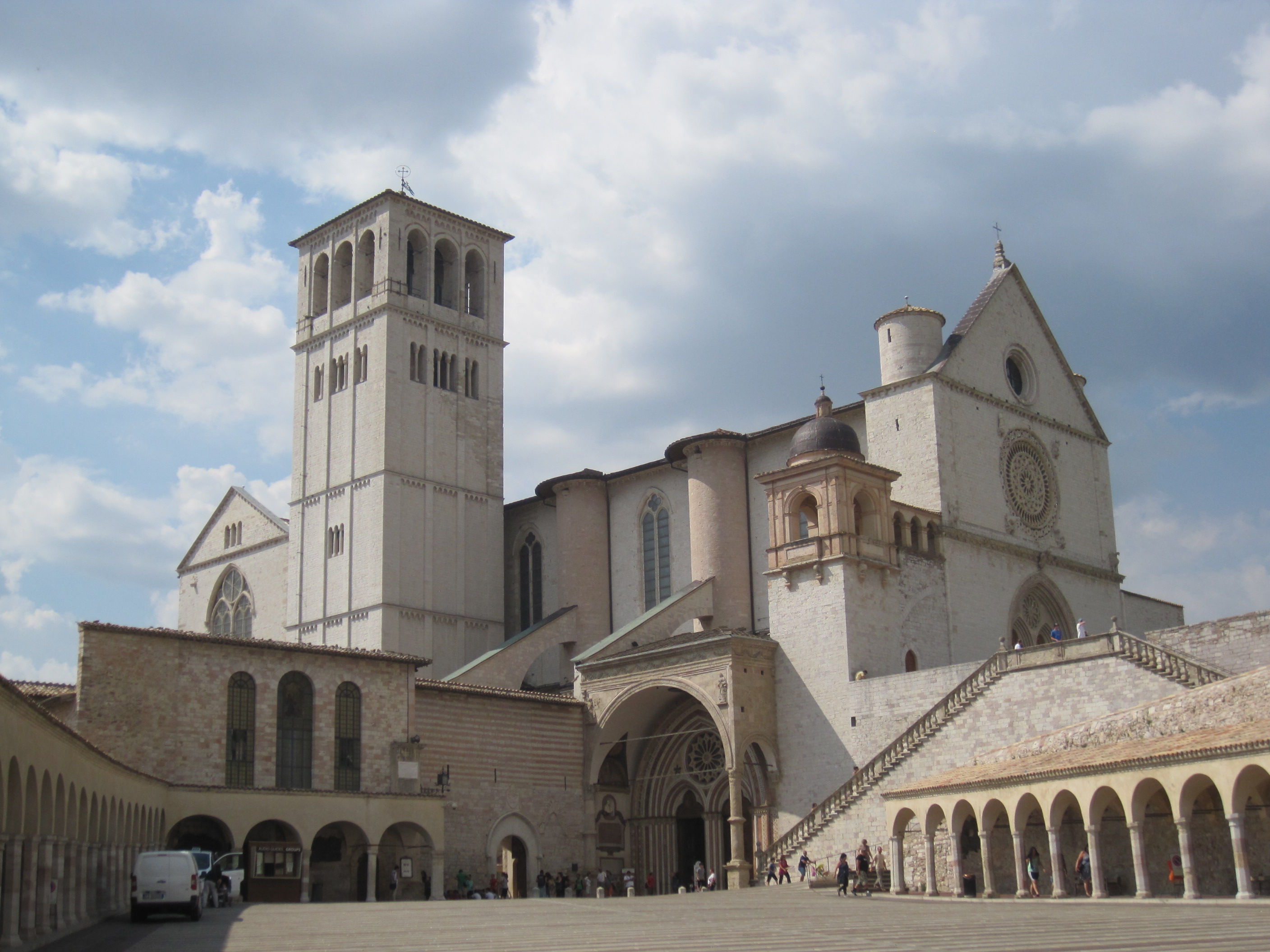
We had a good pizza for lunch where it was cool in a restaurant in a kind of cave in the hillside. The Basilica of St Francis was a must and we trooped round all of it trying to avoid a lot of tour groups. There are actually two churches, one built on top of the other with frescoes on all the walls. A gelato finished our day in Assisi and another nice dinner finished our stay in the area.

Basilica of St Francis, Assisi

Basilica of St Francis, Assisi

Abruzzo

We stocked up with food again before setting off southwards into the mountains of Abruzzo, one of the lesser known parts of Italy. We passed L’Aquila where there was still a lot of damage from the earthquake of 2009. They seemed to be rebuilding about 5km away. Then we took a short detour to the village of Bominaco where there are two 13th churches. The interior of the smaller (San Pellegrino) one was covered in beautiful frescoes. The larger one (Santa Maria Assunta) had lovely carvings on the outside.

San Pellegrino Church, Bominaco

San Pellegrino Church, Bominaco

The mountains were quite spectacular and finally we got away from the main tourist crowds. Thanks again to the Rough Guide, we had identified the area of Scanno as a good place to head for. We found a nice B&B with our own kitchen by Lake Scanno.

Getting there was interesting as we were on a narrow road half way up a mountain with a steep drop into a deep gorge on the left. There was a sort of crash barrier, but I’m glad we didn’t hit it. The B&B owner sent us to the village of Scanno for dinner to a rather smart hotel which we think was owned by a relative. She spoke excellent English. Most of the guests were Italians and the owner was interested to hear about our travels, even though we had only been gone a week.

Scanno is an amazing place. It’s all perched on the top of a hill and the streets are little alleyways . And it was quiet, with just a few tourists.

We drove on through the Abruzzo National Park. It was fairly high up with no trees in places. One spot was like home from home as we saw a large flock of sheep. The difference between there and Yorkshire is that the Italian shepherd is with the sheep all the time – and he doesn’t have a quad bike.

There are supposed to be some wolves in the area and we stopped at the wolf museum at Civitella Alfadena. It was all very interesting but there were no wolves. Apparently it’s very rare to see one even when you go out hiking a long way off the beaten track.

Trulli in Puglia

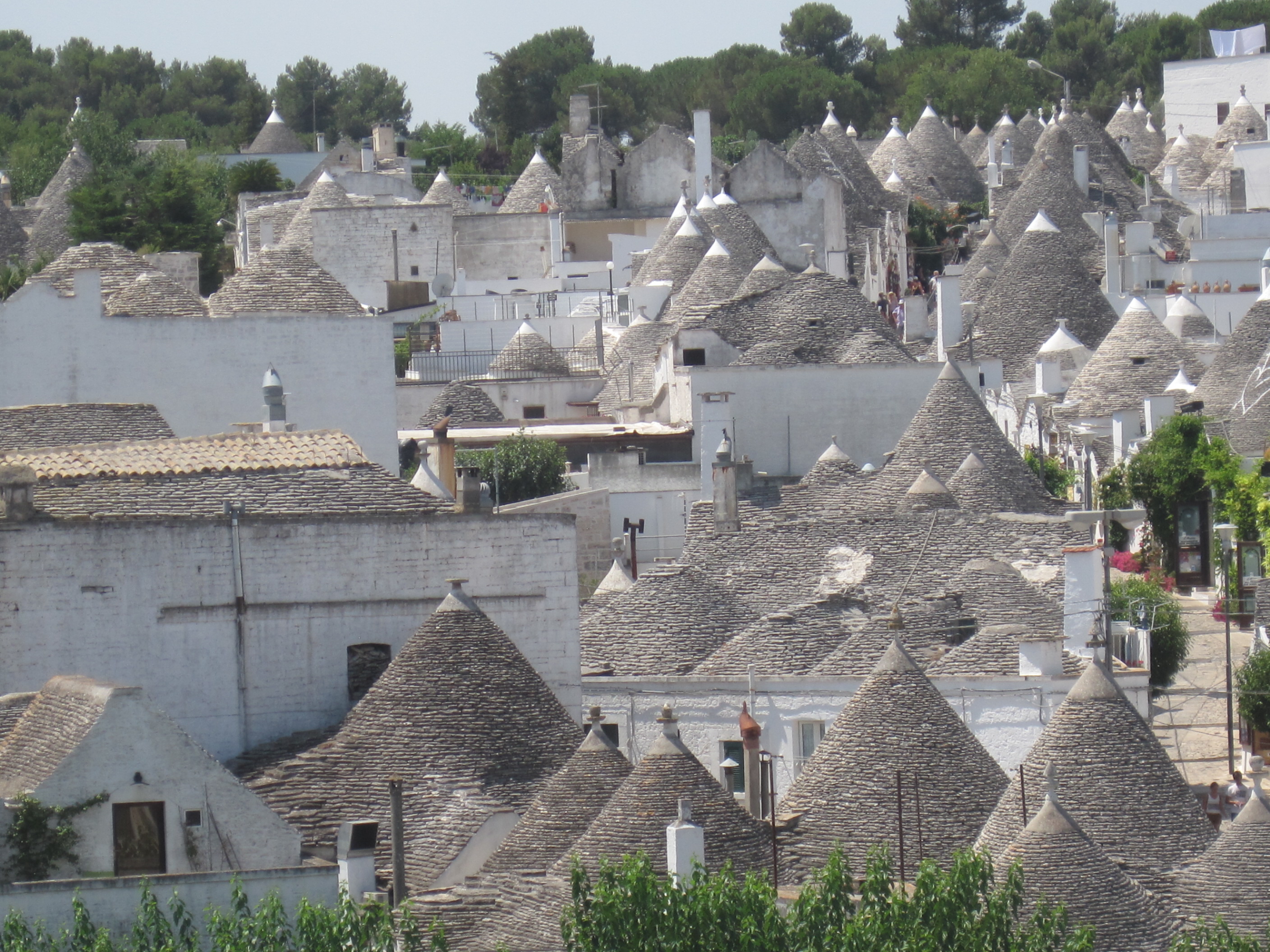
Then we were back on the motorway to past Bari where we turned off for Coreggia. It's small village close to Alberobello and the HPB have just 8 trulli which are weird circular buildings with high conical roofs. In ours the bedroom was in the trullo and the other living space was a white washed stone building attached.

Our trullo, bedroom end

Our trullo, bedroom end

We went to Alberobello later on in the hope of finding somewhere to eat but there was a big festival going in and all the car parks were full, so we just went to the supermarket and bought some mediterranean food to cook. In the end I preferred this as we had had restaurant dinners every day since we left home.

By now we had done 1985 miles (in 10 days).

We had a quieter week at Coreggia. We arrived on the Saturday evening. On the Sunday, very surprisingly for us, we did not go anywhere, just caught up on e-mail and reading.

Monday was for looking round the town of Alberobello where most of the trulli are. I am not surprised that one guidebook describes it as “Disneyland” as they are all higgledy piggledy and the view looking down on them from the higher new part was quite comical. We walked all around the main trulli area (lots of tourists again).

Alberobello, the "Disneyland" of Puglia

Alberobello, the “Disneyland” of Puglia

The main church in Alberobello is several trulli put together and we also went in the only two-storey trullo which more of a trulli museum with furniture and fittings. Another trullo had a model of the entire trulli area inside. Some of them have symbols on the conical roofs and we found a board explaining their significance. Plenty of them are restaurants and we had a nice dinner on a terrace outside a trullo restaurant.

Lecce and Otranto

The next day we drove to Lecce which is one of the major tourist towns in Puglia. We parked at the bus terminal and took a bus into the centre. The tourist office was right next to a Roman amphitheatre in the middle of the town. The front of the Basilica di Santa Croce had probably the most ornate stonework I have ever seen. It would take hours to look at it all in detail. We had another nice pizza for lunch and then drove on to Otranto on the coast.

The main thing to see in Otranto is the floor of the Cattedrale di Santa Maria
Annunziata which is a huge 12thc mosaic with the “Tree of Life” as its main theme.

Part of the mosaic floor, cathedral at Otranto

Part of the mosaic floor in the cathedral at Otranto

Since we had got so far we decided to go on further along a spectacular coast road to the Cape Santa Maria di Leuca which is the tip of the heel of Italy, where, apart from the ocean views, the main sight is yet another ornate church. It got dark as we drove back and so we stopped to eat at a fish restaurant right on the sea near Torre Canne. It didn’t seem like they were used to foreign customers, but we did manage to order some food.

This was a long day, 249 miles, but well worth it.

Locorotondo and Matera

On the Wednesday we found that there were developments on yet another planning application (actually the 12th) on the site next to our house in Oxford and had
to read up about this, but we did find time to visit Locorotondo a hill-top town not far from Coreggia where there are some lovely white-washed narrow streets. It was very hot again.

The town of Matera is a must-see in southern Italy. The old part of Matera consists of hillsides riddled with cave houses (and churches) in an area called the Sassi. Apparently people lived there until the 1950s. It’s only an hour or so from Coreggia.

There was a big thunderstorm when we arrived (the first rain on the trip) and we had to sit in the car for a while. We easily found a space in a parking garage in the new town and it soon dried up after the rain.

The Sassi, Matera

The Sassi, Matera

We wandered down the Sassi right to the river at the bottom. We visited the one house which has been furnished as a kind of museum, complete with model horse in the place where they kept their animals, almost next to the bed. The best church is built inside a rock in the middle of the Sassi and has 14th century frescoes. It was very hot again and we walked round almost all of Matera with a lunch stop in the piazza by the cathedral. Martin had the energy to go on a tour of underground cisterns while I had a gelato again. We had been in Matera 6 hours – well worth it.

Deciding to go to Greece

It was only towards the end of this week that we decided to go to Greece. The gloom about empty ATMs seemed to have abated a bit and we knew that we could get through the northern part of Greece on one tank full of diesel if we had to. We couldn’t really turn down a chance to go to our favourite country, could we?

Our last full day at Coreggia was another quiet day planning for Greece and doing some chores. Miraculously our trullo had a washing machine and I managed to get all our clothes clean before we set off again. We went out to Locorotondo for dinner and ate in one of the restaurants in an alleyway of whitewashed houses.

Last day in Puglia

We had booked the ferry to Greece for Sunday and so we had one more night in Puglia. Our main activity on our last full day in Italy was to see the huge cave complex called the Grotte di Castellana which is a bit south of Bari. We managed to get on an English-speaking version of the long tour which is 3km and about 2 hours. We were only allowed photos at the start. The guide was excellent and told us just what to expect. At one stage we had to walk 500m through a tunnel to get from one part to the next. There were amazing configurations of stalactites and stalagmites. It was all very well organized. They had guides positioned at various places inside the caves who would see you out if you had had enough. And, there was a lift to come up.

We also paid a brief visit to the Castel del Monte, a strange octagonal castle on the top of a hill which was built by Frederick II about 1240. Much of the building has been restored but there’s almost nothing inside and nobody knows why it was built. It’s really best seen from some way off. Our visit was curtailed a bit by the threat of a thunderstorm.

Our last night in Italy was spent in a rural B&B not far from the Castel del Monte, which, when we finally found it, was lovely. We had an excellent dinner there outside.

The ferry to Greece

Getting on the ferry (Superfast) was interesting to say the least. We were told to get there at least 2 hours ahead of the schedule departure at 13.30. We had a printout of our booking, but when we finally found our way through Bari (thank goodness it was a Sunday and quiet) and got to the front of the queue, we were told we had to go back to the ferry terminal to exchange the printout for real tickets. By then (only 11.30) there wasn’t much of a wait to get on the boat, that is for cars.

We had to reverse the car down a ramp to a lower vehicle deck guided by a man whose only three words of English seemed to be “left”, “right” and “wiggly”.

Then the trucks started loading and they had to reverse down the ramp as well. It was all a bit different from Dover where they can turn round a huge ferry in 45 minutes.

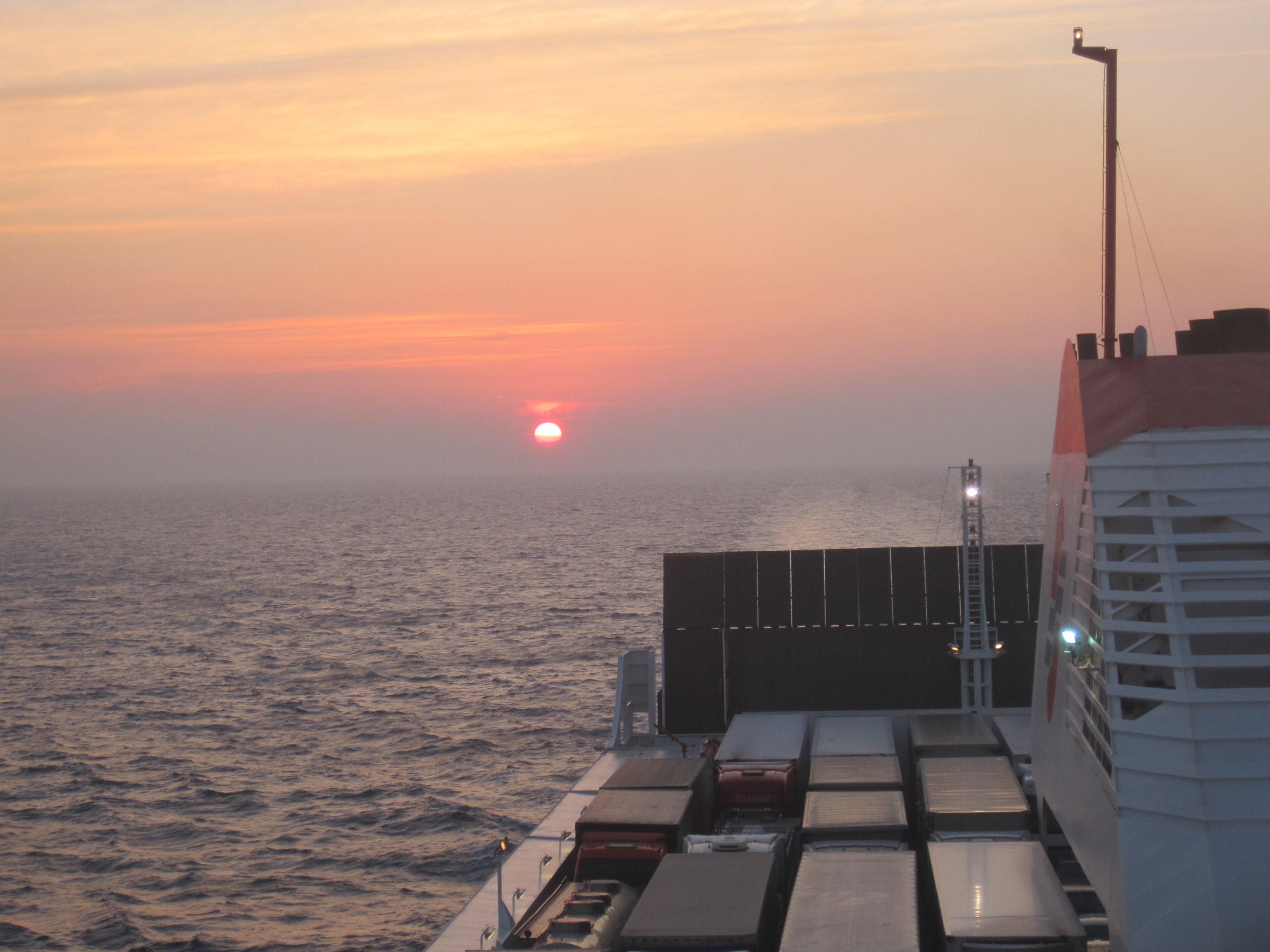
Not surprisingly the ferry left late. We were glad we had booked seats in the air-conditioned lounge as the ship was pretty full, mostly with Italians going to Greece for holidays. There was no wifi but we had plenty to read and the cafeteria served rather good food. Sunset over the Ionian sea was spectacular and it was still light enough to see Corfu.

Sunset on the Ionia Sea

Sunset on the Ionia Sea

The ship finally arrived in Igoumenitsa just before midnight Greek time. Driving off was also rather chaotic, but at least we didn’t have to reverse. We found our hotel in Igoumenitsa easily. The owner was sitting outside waiting for his busy time when the boat arrives – there is nothing much else at Igoumenitsa.

We had done 532 miles between arriving in Coreggia and the hotel in Igoumenitsa.

You can see all of the pictures for this part of our trip here

Posted in Uncategorized | Leave a comment